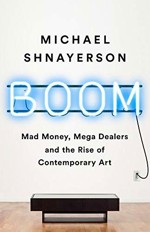
“I absolutely loved this book. It explains the world of contemporary art – who buys it, how it sells, and why it becomes valuable. Lots of books seek to explain things like this, but they think they can do it through anecdotes and vignettes. The books spend each chapter focused on a person. They…”
“I bailed out on this book at exactly the halfway point (50% on the nose, according to my Kindle). I had such high hopes, but the book was essentially just a recitation of the lives of the people who lived at 740 Park Ave. Chapter after chapter was a dissection of these people’s lives, to the point…”
“A good overall discussion of A/B testing. More strategic than tactical – this is a book to convince executives to try experimentation, not for marketers to apply it. (Disclaimer: it was written by the founder of Optimizely, which is sort of the company I work for now. We acquired them, then took…”
“This New York Times article has introduced me to something I didn’t know existed: litigation financing. Lawsuits are expensive, and investors will fund your legal fees if they think you can win, and then take a cut of the proceeds. Wall St. Bankrolls Ex-Executive as He Sues Over A.I.G. Bailout The…”
“An interesting book, but also not what the title would suggest – the subtitle anyway. This was not an all-encompassing history of money and finance. The book starts with Jewish moneylenders in Venice, and then goes on to discuss the bond market, the stock market, real estate, etc. It’s basically a…”
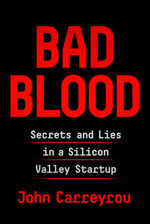
“An appalling, infuriating book about shocking hubris and dishonesty. The fact that Theranos managed to perpetuate their fraud as long as they did is frankly a little amazing. And all these people who so vigorously defended the company and denigrated its detractors simply HAD to know there was a…”
“Despite the subtitle, this is mostly about government’s usage of consultants. It goes into the history of consulting, and how we ended up with the Big Three consultancies (McKinsey, Boston Consulting Group, and Bain and Company) and the Big Four accounting firms (Ernst and Young, Deloitte, KPMG,…”
“This book is meant to describe a new approach/strategy to marketing. The ‘blue ocean’ strategy means that you find some aspect of your market that no one is doing, and try to dominate that, rather than fighting it out with other vendors in your space – which is a ‘red ocean’ strategy. It’s a good…”
“I think I loved the idea of this book more than the reality of it. She presents a really intriguing concept – consider your entire professional history together as your ‘body of work’ rather than individual jobs. However, the result is scattered. There are flashes of brilliance toward her topic,…”
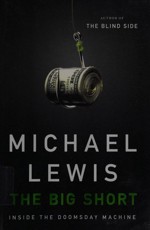
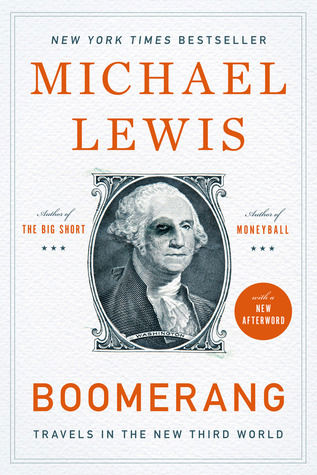
“This is a book that got written accidentally – in preparing to write ‘The Big Short,’ Michael Lewis realized he had enough material on country-specific bubbles to write another book. This is that book. Each chapter is a look at a particular country – Iceland, Ireland, Germany, California (almost a…”
“This is an economic model used to reduce carbon emissions. A government sets a ‘cap’ on the total amount of emissions to be allowed, and they sell ‘permits’ or ‘certificates’ or ‘credits’ which allow organizations to emit a certain amount against that cap. The goal is to slowly reduce the cap every…”
“ Meant to be a powerful business fable, the book comes across as shallow and clichéd. It’s poorly written fiction with an obvious point which is repeated over and over and over. ”
“This is a weird one. This is both a review of this book, and experiment in reading style and strategy. I decided to try something new with this book: I decided to give it one hour of my time, and see how much I could get out of it. If you search for ‘how to read like a graduate student,’ you’ll…”
“Note: I did a much deeper re-read of this book a few years after my first reading. Scroll past the initial review for that deeper dive. This is the story of Pixar, from one of the founders. It reads like a standard business history until the second part, where he gets into some of the specific…”
“So, weird situation with this book – I don’t remember a lot about it. I had sitting on my chair table for a month or so. Turns out I read it, I just don’t remember it. So I paged through it, and I now remember why I don’t remember it – and that’s an interesting point in itself. The book is so…”
“I bought this book due to my obsession with Harry Nyquist. I wrote about Nyquist on LinkedIn after I read How to Know a Person , and someone mentioned that this book talked about him as the well. The book is a solid introduction to all the things that make for a ‘good culture.’ Things like…”
“I didn’t get into this. I thought it was an examination of the financial type of debt, but it literally starts way back at the dawn of civilization with the idea of moral debt – ‘I owe you my life,’ and such. Then it progresses laboriously forward through a long period of human debt – slavery and…”
“I abandoned this book, but not by choice – truth is, I lost it about 2/3s of the way through (it’s a physically small book, and thus easy to lose). The book was…okay. True to the tag line, it presents a series of thought models with which to evaluate decisions. Some I had heard of (Pareto, SWOT,…”
“Deals in the generalities of working deeply, without distraction. It spends a lot of time trying to prove the value, which I didn’t think was necessary. And it seemed short on details or concrete plans. It had four principles, which were valuable, but I looked at the book more as motivation or…”
“A very complete look at all the steps necessary to manage devops in a software shop. Some of it was lost on me, because it’s exactly what it purported to be: a comprehensive review of everything you might do to manage the process of releasing and supporting software. Of interest was some emphasis…”
“This is an economic phenomenon where a drastic improvement in one part of country’s economy leads to a decline in other parts. Specifically, it refers to the rise in the valuation of the Dutch guilder when a large oil field was discovered in the late 1950s. This caused exports to be more expensive,…”
“The one lesson is this: you have to consider ALL effects of economic intervention. The author claims that too many people intervene in the economy by only considering the effect on one group of people, not acknowledging that their change has also affected another group. The author is from the…”
“Fascinating story of Huguette Clark, the youngest daughter of mining baron W.A. Clark. She was fabulously wealthy, but reclusive and eccentric. She maintained ‘empty mansions’ that she never lived in, and even spent the last 20-ish years of her life contentedly living in a hospital room. (How do…”
“Apparently the population of the planet will start to recede very soon. As sexual education and contraception gains hold around the world, birth rates are dropping below the 2.1 required to stabilize the population. This book is fundamentally about demographics, the changes that have brought us to…”
“This is a classic business strategy book by the author of ‘Crossing the Chasm.’ It’s not really practical advice – the author concedes that it’s a ‘framework of frameworks’ that help you think about your company’s future. More specifically, he talks about ‘power’ in several domains: Category Power:…”
“What can get mystifying about politics is that opposing politicians can have such different opinions about political issues. It seems like they can never agree about what to do about a given situation even though both sides are presented with the same facts. A large part of politics is about…”
“I love Steven Johnson, but this one was rough. It was…muddled. I’m still having trouble figuring out what his core premise was. He weaved in an out of it, and the book never seemed to have a central pillar to rally around. Then, at the end, he goes into a 20-page examination of the novel…”
“This is a perfect example of ‘be careful what you wish for…’ I wanted a detailed examination of the federal budget. This book is that thing. I did not like it. The book goes deep into the process of the federal budget – how the different parties argue about it, and the tricks they use to disguise…”
“Kind of an odd book, but really interesting and entertaining, far beyond the original point. The book starts out as a condemnation of the Trump administration, on a specific point – they didn’t bother to staff important agencies. Lewis paints a portrait of a man who honestly didn’t think he’d win…”
“It’s ironic that I haven’t written a review for this book yet (I’m writing these words fully six months after I read the book). This book might have affected my life more than any other. I have recommended it to thousands of people via social media, and dozens of people in multiple countries have…”
“This both a history of Koch Industries and the details of a management philosophy that Charles Koch calls ‘market based management’ (MBM). The book is at its best when he’s explaining some of the history of the company and demonstrating principles via specific examples. Two drawbacks: (1) Koch…”
“Enormously entertaining book about the Beanie Baby craze of the mid and late 90s. The book goes deep into Ty Warner’s backstory. He’s the founder of the company that bears his first name. He’s a man who spent his entire career in ‘plush,’ which is the industry term for stuffed animals. Warner is an…”
“This is a well-researched book, but seems disorganized. It felt like it jumped around a lot, especially between scopes – from macro to micro. The major points I learned: Electricity is unlike any other resource in that it’s not a storable thing. When you use it, it was generated a fraction of a…”
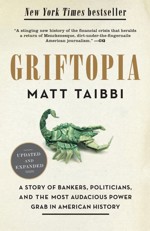
“I bailed out on this book about a third of the way in because it doesn’t really have a point. The only point is that the author is pissed off and wants to rant about stuff. The author is kind of an Internet personality. He was an editor for Rolling Stone , he has a podcast and a Substack, and last…”
“This book is a legendary examination of how companies handle ‘innovation,’ by which the author means new aspects of their business that come out of nowhere and eventually come to dominate their markets. The problem: you can’t just give customers what they ask for. Because lots of customers actually…”
“Amazingly wonderful book on the history of the digital age, all the way from Ada Lovelace and Charles Babbage through to Sergey Brin and Larry Page. Wonderfully written, always engrossing. It begins with a long discussion of Lovelace, Babbage, and Turing’s thoughts on whether a machine could ever…”
“John Maynard Keynes was a British economist. He had a lot of theories about economics, but it basically boils down to this – The government has to intervene in the economy . In a rescission, government has to increase spending to increase demand. During a boom, the government needs to reduce…”
“This is another book to which I gave every chance, but I eventually abandoned because it just never proved its point. The author is apparently quite famous in politically conservative circles. His prior book – Wealth and Poverty – was well-known, and I gather that he had something to do with…”
“Malcolm Gladwell could have written this book. It’s exactly like a Gladwell book – dozens of seemingly unrelated anecdotes and stories, ostensibly in support of a central thesis… but not really. Like Gladwell, I’m convinced this author just wanted to tell stories. To do this, he needed an idea,…”
“ Turns out, ‘strategy’ is fairly new in business. This is the story of the Big Three business strategy firms – Bain, BCG, and McKinsey – how they created a new industry throughout the 20th century. ”
“According to Karl Marx, this is the lowest class. This is the working class – the classic Proletariot – but so ignorant that they’re not even aware of their situation, and don’t care about any class warfare. They have either accepted their fate, or simply aren’t aware that they are being exploited….”
“this is a solid book about larger scale digital governance. i say ‘larger scale’ because it’s primarily about how to get order at the higher-levels – c-level, vp level, and steering committee level. this differentiates ‘governance’ and ‘operations’ for me: governance is Big Picture steering, where…”
“A book which counters claims of Left-wing media bias. Chomsky actually claims the media is biased towards big business and government and provides a ‘propaganda model’ which he claims demonstrates it. The rest of the book is mainly history – Chomsky uses things like some murders in Central America,…”
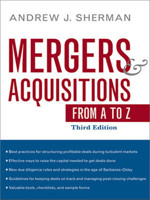
“ A well-done book which is everything it claims to be – all the stuff about M&A from the start (why do it) to the end (challenges in integrating the companies; alternatives to M&A). Some of it is tedious, but so is the subject matter, really. ”
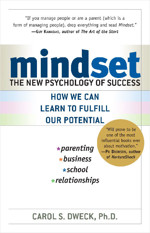
“The core point of this book is fantastic and wonderful: we are creatures of growth, and if we approach our lives with the mindset that we can change and are not fixed, then it will have a huge impact on our development and potential. That’s it – you could have written that in a blog post. But the…”
“This is a weird and wonderful book. The author is a private investigator, and it seems he just decided to write a book one day about cases he’s worked on. And the book is really good . Each chapter details a separate case, and goes deep into details. You find that being a corporate PI is not about…”
“This is about all the problems faced by women, mostly in the Third World. Unpaid labor, domestic abuse, child marriage, genital cutting, etc. Fundamentally, the book is about women’s equality, and I commend Gates for revealing considerable details about her marriage to Bill. She goes on for many…”
“This is opposite of a monopoly. In a monopoly, there is a single seller and lots of buyers, allowing the seller to control the market. In a monopsony, there is a single buyer , which allows the buyer to control the market. For example, if you manufacture trigger mechanisms for nuclear warheads, you…”
“Honestly, I didn’t totally get this book. The basic premise is that there are ‘narratives’ that drive economics. There are stories or explanations of things that we believe, and that cause economic things to happen. Some examples, from the book: Sellers can go into panic mode The Gold Standard is…”
“So, this is an objectively good book, but would be hard to put into practice I think. The author (well, I think he had a ghostwriter) is/was an FBI hostage negotiator. He has a LOT of stories about negotiating. He also has tips, some of which are about human psychology (let them say ‘no’ because…”
“I was going to rate this book even lower, because it was just stratospheric in scope – it was so high-level as to be basically useless. There was just nothing at all tactical here; it was full of generalities that, honestly, seemed a little obvious. Additionally, the book seemed like a long…”
“Student loan debt exceeds credit card debt in USA : I think the student loan bubble is the next one to burst: Total student loan debt exceeds total credit card debt in this country, with $850 billion outstanding […] […] With tuition far outpacing inflation for the past 20 years, student borrowing…”
“This is a book about behavioral economics – why humans make the choices they do, and how they can be persuaded to make other choices. Well, not ‘persuaded’ so much, but rather – wait for it – nudged . A ‘nudge’ is a change to how a choice is framed or presented that causes people to pick an option…”
“Vaclav Smil is a scientist and policy analyst. His specialty is looking at societal problems and figuring out how science and policy should intersect to make it better. He taught environmental science at the University of Manitoba. Bill Gates has said several times that Smil is one of his favorite…”
“the author of this book makes a good point in the afterword: all facts promote or minimize a viewpoint, merely by their selection. So, choosing to retell or convey a fact promotes some point-of-view because that fact tells a story. And conveying that fact means you want to tell that story, and not…”
“There’s nothing new here, and if you read a lot of productivity or self-improvement books, you won’t get much from it. But if you don’t, and you need to pick one, this would be a good one. The gimmick is that this guy spent one year of his life performing every hack he could think of to improve his…”
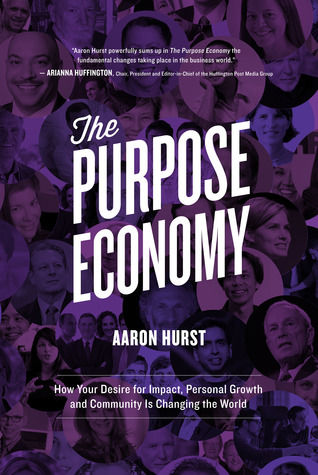
“I read every word of this book and I still don’t understand what the author was trying to say. He’s clearly trying to start a movement of some kind – he puts ‘the purpose economy’ up there with ‘the industrial economy’ and ‘the information economy,’ for example – but I can’t figure out for what….”
“A good overview of how technology is changing the employment landscape. Technology is eliminating jobs, and the authors present the case, along with 19 things we need to do as a society to increase innovation to make up the difference. We need to keep innovating to create new jobs to replace the…”
“Interesting book about how generalists have value, and there might be a myth about those single-minded people who start in one discipline and stay there. It’s good, but the different chapters are not well-differentiated – the titles are vague, and I had trouble following the development of the…”
“I’m not an economist, but I’m fairly confident in a couple of economic principles. Inflation tells us that when there’s more money chasing the same amount of goods, prices will go up. Supply and demand tell us that when demand increases, prices will also go up. I read an article ( How the ‘creative…”
“This was on many ‘best of’ books for 2015, It’s a broad overview of the problems of automation and the potential effects on the economy and society. Beyond the standard litany of automation horror stories, Ford offers some interesting analysis, primarily in seven reasons why the answer to the…”
“This book is undoubtedly interesting, but it’s a bit meandering. The basic idea is that…things (anything, apparently), ‘scale’ according to universal laws. Meaning, as something gets bigger, it grows less linearly along different axes, and this is a very predictable phenomenon. For example, an…”
“At first, I didn’t like this book, but it won me over in the end. At its heart, it’s about confirmation bias – how we defend our positions by acknowledge evidence in favor of them and ignoring or downplaying evidence against them. Galef calls this ‘the soldier mindset,’ because we’re always…”
“I’ll basically read anything Cal Newport writes. After So Good They Can’t Ignore You and Deep Work , I was just hooked on the dream he offers – deep work, without interruption, toward tangible, consistent results. Mind you, it’s a dream I’ve never quite been able to reach, but I keep reaching for…”
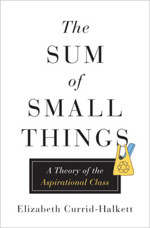
“ Vaguely interesting book about how people spend their money on ‘luxury’ items in order to publicly denote a certain level of social class. Lots of figures, graphs, etc. Not 100% of the point that it was trying to get at, honestly. ”
“ Highly readable discussion about how hard it is to predict the future, and all the cognitive traps we fall into when we try to do so. Includes a handy list of Ten Commandments (actually 11) of Super Forecasting. ”
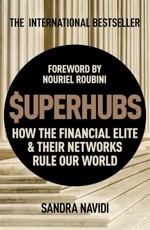
“The book is about all the large-scale economic players and theatrics that happen behind the scenes. This is the world of George Soros and Long-Term Capital Management and Bilderberg and Davos and the IMF and the World Bank. It’s the world where billionaires make moves and countermoves that make…”
“Extremely readable summary of pop psychology hacks for making change. It still runs into the problem that people are generally hard-pressed to put these things to use, but it’s well-written and enjoyable. It concentrates a bit more on the approach than other books, which might be key – the sad fact…”
“This was just okay. The author presents nine points to make you give better TED-like presentations. It’s padded – some of the lessons are obvious, and the author gets really repetitive trying to stretch them out for an entire chapter. Additionally, she keeps going over the same TED talks again and…”
“ Astonishingly good book with a title that doesn’t do it justice. This is one of the most profound books I’ve read on human communication and self-perception. I will re-read this again, likely multiple times. ”
“ Lovely introduction to general systems theory. You come to understand that a ‘system’ can be almost anything, defined by inputs, outputs, rules, buffers, etc. The book discussed how systems can be effected and changed over time. Exactly what I was looking for. ”
“This is the story of one week in 2008 – the week when Lehman Brothers was about to fail, and then almost everything went with it. It was the week that ended with TARP – the $700 billion Wall Street bailout package. And to be clear: this is 600 pages about that one week . It’s a nauseatingly…”
“An excellent look at how metrics can be used poorly to justify bad policies. Either we measure the wrong thing, measure it the wrong way, or – more often than not – game the measurement system so that we look better than we are. Want it to look like your city’s crime rate is going down? Stop taking…”
“A solid introduction to the net promoter score methodology of performance reporting that falls into a common trap: it could be a blog post, or a 30-page ebook. To get this thing published, the authors had to pad it out to book length, and it’s just way, way, way long. It talks about the same…”
“Interesting look at nine factors that are powering the pace of change in the world. I liked the dialectical format – each principle is set against the status quo in an ‘X vs. Y’ format. I feel like the entire book boiled down to, ‘bottom up is winning against top down.’ Well-written, with lots of…”
“This is the story of class in America. Specifically the ‘lower’ class. In contrast to the Utopian image of Colonial America, the early years of the country were marked with extreme poverty. Before the slave trade geared up, most of the people sent to the New World were poor white people,…”
“This is an enormously conceptual book, and is more about economics than information. The author makes the claim that the functionality and ordering of atoms (?) in physical products is information, and this grows with economies. A computer is only worth more than the plastic and chemicals its made…”
“ This video was shown at a Rotary lunch by the president of the local technical school. It lays out a solid (and entertaining) case that college isn’t for everyone, and you shouldn’t go ‘just to go.’ ”
“Tedious book. Seemed a bit scattered. The gist appears to be that the biggest reason nations fail is because of unfair, ‘extractive’ institutions, like dictatorships, that give people little incentive to work and are designed to enrich a few. The book goes on about this for 460+ pages, with example…”
“I have a theory: the U.S. economy requires a significant number of Americans to be stupid with money. If we ever all got our crap together and started managing our personal budgets responsibly, the economy might fall apart. Consider this article from Bloomberg this morning: Americans Can’t Help…”
“I actually quit this book part way through, which I’m loathe to do, but the simple fact is that I was reading it seven years too late. It was written in 2006. Things that were revolutionary then just aren’t anymore. This is made even more apparent by a breathless, hyperbolic writing style that made…”
“A few chapters in, I was prepared to dismiss this as just another collection of idealized, ‘aren’t we amazing’ ways of doing things at a hip, with-it company…but it got better. The book is written by the head of HR at Google, and describes all of the ‘Google-ly’ things they do for their employees….”
“A book about entrepreneurship and thinking up the next great idea. It’s at its best when talking about the theoretical marketplace, how new ideas fit needs, and different perspectives on how people view the future. It’s get worse when it gets more specific about how to start something up. Mixed…”