Shoot for the Moon: The Space Race and the Extraordinary Voyage of Apollo 11
TLDR: “A definitive history”
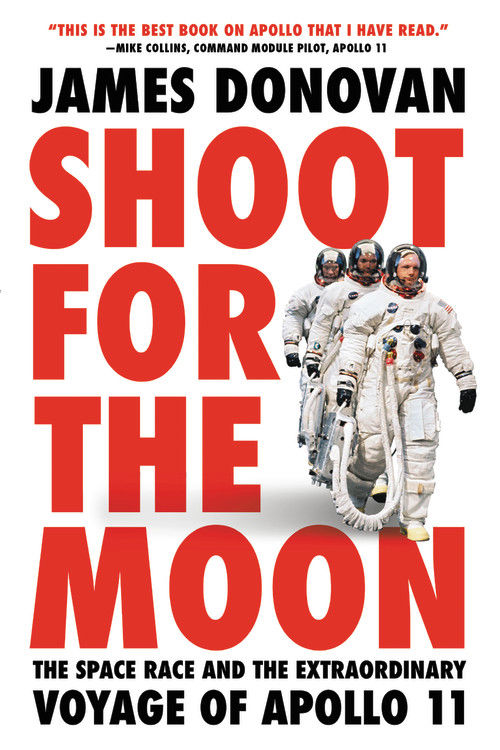
I read this because NASA’s Artemis mission was in the news, and I felt kinda of guilty that I don’t follow space much. It’s poor geek cred, I know, but outside of childhood, I’ve just never been that interested in space exploration.
But my brother got me to watch an Apollo 11 documentary, and it was really compelling. It was amazing how many problems NASA encountered and fixed during the race to get the moon. So, after watching that, I asked AI what the canonical history of space exploration was, and it recommended this.
The book is quite good. It starts at Sputnik in 1957 and goes through the manned landing on the moon – Apollo 11 – in 1969. In the process, it goes through the Mercury and Gemini programs in detail, and all the missions leading up to Apollo 11. It stops pretty abruptly at that point.
It spends a lot of time on the personalities. The Mercury Seven were the astronauts who became celebrities at the time – a local car dealer gave them all Corvettes, and they were the prototype of the dashing hero. Some of them drank too much and bedded a lot of the local women around Cape Canaveral.
There was a lot of competition between them – they all wanted to be the first to do everything. Buzz Aldrin in particular was pretty annoyed that Neil Armstrong was going to set foot on the moon a couple minutes before him, and he shamelessly lobbied to reverse the order. They were all headstrong and a bit arrogant, and unlike today’s space flights, they held a lot of power in the cockpit (one of them in particular ignored orders and jeopardized a mission, so was never allowed to fly again).
I found it interesting that the country wasn’t as interested in space exploration as we think it was. During the 60s, the American public didn’t care so much after the novelty wore off, and there were some complaints that we were spending too much money on it.
(I remember, when I was a pre-teen, watching the first Space Shuttle mission. But towards the end of that program, I didn’t even know when or if we had a shuttle in orbit. Things are miraculous when they first happen, then become mundane weirdly fast.)
Also interesting were the dynamics of the “race” between the U.S. and the Soviet Union. They, of course, had the first satellite and human in space, which put us behind, and led to the famous “missile gap” fear mongering. A lot of what the Soviets did during the 60s is murky – several cosmonauts died in the process, and we don’t really have a full accounting of it.
But, when the U.S. made our moonshot, the Soviets acquiesced to tacit support. They had a spacecraft orbiting the moon at the time, and they gave us its location and trajectory to ensure it wouldn’t interfere. Additionally, when the U.S. astronauts placed their plaque on the moon commemorating the men who died during the pursuit (mainly the Apollo 1 crew), they added some deceased Soviet cosmonauts to the list.
The book is well-written. It’s never boring and deftly toes the line between lots of detail and not too much that it bogs down. It’s a great history of the moonshot project.
Book Data
- Author
- James Donovan
- Year
- Pages
- 464
- Acquired
- Not recorded
- Open Library
- OL20159163W
- I have read this book. According to my records, I completed it on .
- A hardcover copy of this book is currently in my home library.