Normal Accidents: Living with High-Risk Technologies.
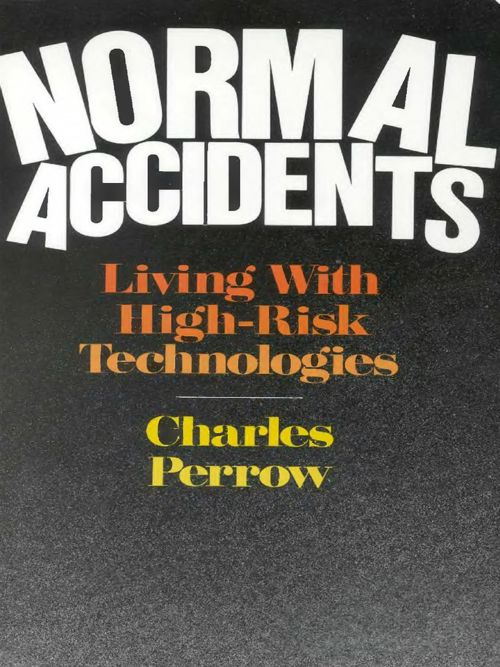
This was apparently a revolutionary book, back when it was published. It pushed back on the idea that industrial accidents were usually the fault of human error. It advaned the idea that in the world of connected systems, humans simply be expected to understand the ultimate ramifications of everything they do, and we have to start putting some responsibility on the systems themselves.
The author goes deep into the Three Mile Island accident in particular. He talks about all the failures that had to happen leading up to the accident, and the list is considerable. Maintenance was delayed, a pump failed, systems designed to be backups failed, etc. There was, at some level, a human error, but so many other things in the chain went wrong, that you can’t pin the blame solely on that.
In general:
Industrial systems have become so complex that humans cannot always accurately predict the future state that will result from an individual action
Backup systems fail as often as – or perhaps more often – than primary systems. Just saying, “We have a backup isn’t enough.”
Humans act irrationally when stressed. They miss very simple things.
Having “slack” in a process can be helpful. While it may seem more efficient to automate everything, having “circuit breakers” where a chain reaction stops and waits can give humans time to react to a negative outcome.
The author attempted to reframe accidents as problems of the systems themselves, rather than the humans that run them. The lack of a human ability to manage the system should be viewed as a problem of the system, not of the human. The solution isn’t to get better humans or blame them when things go wrong, rather the solution is to design systems that account for human fallibility better.
Book Data
- Author
- Charles Perrow
- Year
- Pages
- 386
- Acquired
- Not recorded
- Open Library
- OL4468929W
- Wikipedia
- Normal_Accidents
- I have read this book. According to my records, I completed it on .
- I own (or have license to) an electronic copy of this book.