“Fantastic overview of the VC/angel process. Even if you’re on the other side – so, not investing, but looking at taking investment money – it gives you a good understanding of the entire process. If you do want to become an investor, the book is a little silly. It assumes you have hundreds of…”
“An interesting book, but also not what the title would suggest – the subtitle anyway. This was not an all-encompassing history of money and finance. The book starts with Jewish moneylenders in Venice, and then goes on to discuss the bond market, the stock market, real estate, etc. It’s basically a…”
“A practical book about fundraising – it explains the step-by-step process of setting appointments, laying out your case, and asking for money. If you’re nervous about fund-raising, I don’t think this book will help. It has a number of scripted exchanges that, frankly, freaked me out a little and…”
“A somewhat interest book that confirmed what I already knew – algorithms are taking over the world. The author recaps all sorts of industries where tasks are getting computerized, from medicine to the law to (of course) wall street. He’s very Gladwell-esque – full of anecdotes and illustrations….”
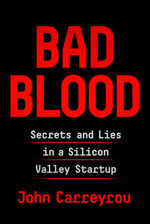
“An appalling, infuriating book about shocking hubris and dishonesty. The fact that Theranos managed to perpetuate their fraud as long as they did is frankly a little amazing. And all these people who so vigorously defended the company and denigrated its detractors simply HAD to know there was a…”
“ This is a company that owns banks, but doesn’t necessarily do banking itself. There are a lot of laws and regulation around banking. A bank holding company – a ‘bancorp’ – operates under different rules than banks, which can make it easier for them to borrow money. ”
“This is NOT a technical book. It’s more about the larger societal and business implications of blockchain – like, how the world will change because blockchain exists. However, the book might have done well with some more technical information. The most frustrating phrase is ‘on the blockchain.’ The…”
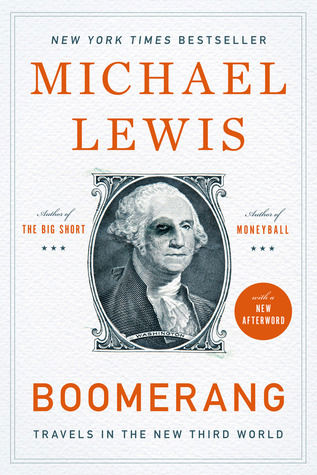
“This is a book that got written accidentally – in preparing to write ‘The Big Short,’ Michael Lewis realized he had enough material on country-specific bubbles to write another book. This is that book. Each chapter is a look at a particular country – Iceland, Ireland, Germany, California (almost a…”
“I freely admit I read this because Bill Gates called it his favorite book. I’m not sure that I agree, but it wasn’t bad. It was written by John Brooks – a business writer for The New Yorker – in the late 60s. The book is a collection of 12 essays about business. One is a long recitation of what…”
“This is short-term, unsecured debt, issued by corporations to fund day-to-day activities. It’s normally effected by selling promissory notes at a discount. To ‘issue’ commercial paper means to ask for a loan, basically. Most buyers of commercial paper are banks and other financial institutions. So…”
“I didn’t get into this. I thought it was an examination of the financial type of debt, but it literally starts way back at the dawn of civilization with the idea of moral debt – ‘I owe you my life,’ and such. Then it progresses laboriously forward through a long period of human debt – slavery and…”
“A book on accounting principles for professional services organizations. It’s not specific to digital – any professional services organization goes through these same problems. It’s okay. I was looking more for something to do with sales, and these’s not much in here about that, except they…”
“It’s an acronym for ‘earnings before interest, taxes, depreciation, and amortization.’ By definition, this will always be larger than ‘normal’ earning figures, which subtract those four things. EBITDA measures the health of a company’s operating business , meaning the things it actually produces to…”
“It is what it claims to be – a detailed history of WWI. Actually, I understand that this is the short version. The author is apparently one of the most renowned WWI scholars in the world, and has a three-volume history in the works, but he decided to make an easier-to-digest version. He approaches…”
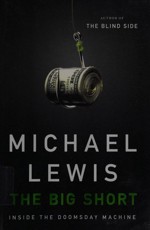
“Michael Lewis could write about anything and it would be interesting. In this book, he tackles High Frequency Trading, and reveals just how absurd and unethical it is. Essentially, trading houses are using technical and ultra-fast communications to bet against their own customers. The entire thing…”
“I bailed out on this book about a third of the way in because it doesn’t really have a point. The only point is that the author is pissed off and wants to rant about stuff. The author is kind of an Internet personality. He was an editor for Rolling Stone , he has a podcast and a Substack, and last…”
“This is an informal, traditional method of money transfer which started in India and is common in Africa and the Middle East. In its simplest form, a Hawala network operates as a set of promises: ‘Can your friend Bob give my friend Ted some money?’ There are four parties to a Hawala transaction:…”
“This is a pooled investment fund where a group of people contribute money, and the total funds are invested with returns to be distributed. Shares in the fund can also be bought and sold. In these senses, it’s no different from a mutual fund. But there are some key differences: Mutual funds are…”
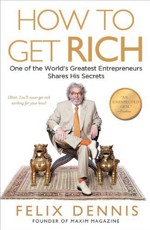
“I read this book because I had heard Felix Dennis was a character, and I wanted to see how someone would explain how they got rich. The book was stupid and unnecessary. It’s really a self-help or motivational. There is no actual practical advice here except for general platitudes about focus,…”
“This is likely the definitive account of The Panama Papers – the massive data leak from the Panamanian law firm Mossack Fonseca. It also covers some other sensational data leaks, like SwissLeaks and Offshore Leaks. It’s good, no doubt. But it’s confusing, and there’s no real way around that. There…”
“ Turns out, ‘strategy’ is fairly new in business. This is the story of the Big Three business strategy firms – Bain, BCG, and McKinsey – how they created a new industry throughout the 20th century. ”
“As the subtitle suggests, this is the history of some of the wealthy Jewish people of American finance. It concentrates on a few of the big names – Joseph, Seligman, Walter Sachs, Jacob Schiff – and some of the big firms – Goldman Sachs, Lehman Brothers, Kuhn-Loeb. Jews left Europe because they…”
“My wife picked this up at an investment advisor’s office. He was giving away to his clients. She asked me to read it. The basic message is this: taxes are very, very low right now. Historically low. So: pay your taxes now . Don’t invest in tax-deferred accounts, because you’ll just have to pay…”
“Very short book about the problem of the US federal budget. It’s not balanced, the deficit keeps growing, and so does the debt. The book details the two basic theories of balancing the budget (reduce spending or raise taxes), and a growing number of people who want to do both. It also lays out some…”
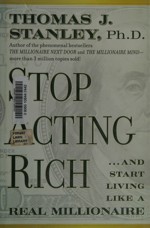
“I quit this book about a quarter of the way through. I had read Stanley’s first book ‘The Millionaire Next Door’ about 20 years ago. As a friend told me, this is essentially the same book. The premise is simple: people who act rich, aren’t. People who really ARE rich often don’t act it. They live…”
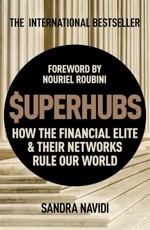
“The book is about all the large-scale economic players and theatrics that happen behind the scenes. This is the world of George Soros and Long-Term Capital Management and Bilderberg and Davos and the IMF and the World Bank. It’s the world where billionaires make moves and countermoves that make…”
“This is the ‘internet for banks,’ basically. It’s a worldwide messaging system which banks use to exchange data and payment orders. If you need to transfer money from one bank to another, this message gets sent along the SWIFT Network. SWIFT technically stands for ‘Society for Worldwide Interbank…”
“TARP – the Troubled Asset Relief Program – was the famous ‘$700 billion bailout’ that the U.S. government undertook in 2008 to try and stave off the mortgage crisis. The crisis that led to this program was the basis for the book (and movie) Too Big To Fail . Did the government lose $700 billion?…”
“Wonderfully written biography. Makes me want to read more Chernow. JDR was a flawed man, certainly. While an upstanding citizen in his personal life, he was a ruthless business, who destroyed his competitors with glee. Provoked some wonder at the line between the personal and professional. Can…”
“This is the story of one week in 2008 – the week when Lehman Brothers was about to fail, and then almost everything went with it. It was the week that ended with TARP – the $700 billion Wall Street bailout package. And to be clear: this is 600 pages about that one week . It’s a nauseatingly…”