Shogun
TLDR: “Historically notable, but very slow and very boring.”
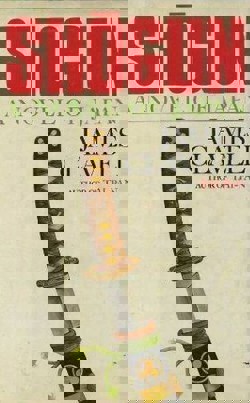
Oh, goodness, I didn’t like this book. And I feel terrible about that fact, because it’s a classic, but I just didn’t.
This is a long, long book. I’ve read comparably long books like The Covenant and The Pillars of the Earth, but this is both long and very, very boring.
It’s set in 1600. John Blackthorne is a ship captain who get stranded with his crew in feudal Japan. What follows is a long study in culture contrasts. Blackthorne and his crew are considered “barbarians” by the Japanese, who are very proper, have a society based on honor and loyalty, and are extremely ritualistic about personal hygiene and living conditions.
What’s interesting, however, is that the Japanese society is pretty barbaric in itself. There’s a lot of killing. Samurai chop people’s heads off for the smallest reason, and it’s quite common to be ordered to commit seppuku, or ritual suicide. And people would do this, without question. Dishonor and “loss of face” is absolutely worse than death in this world.
Blackthorne becomes ingratiated to their society. The Japanese leader, Lord Toranaga, doesn’t want to kill Blackthorne, because he represents an opportunity to expand his empire to the sea. So, he gives Blackthorne a home, a “consort,” and an income, in exchange for his training Toranaga’s troops, and the promise of a Navy that will supply guns and cannon.
Meanwhile, Toranaga is involved in a massive power struggle against other feudal lords. There are huge political machinations going on, and it’s easy to get lost. People move from place to place, have hushed conversations, strike alliances, etc. Honestly, I had the barest understanding of what was going on at any given time.
There are a few of significant subplots:
- Blackthorne and a female samurai beginning to catch feelings for each other; complicated by the fact that she’s married, and her husband is also a samurai
- The Jesuit priests from Portugal are portrayed as devious and calculating; they want Blackthorne dead because they don’t like the idea of a Protestant becoming so powerful
- Blackthorne has a rivalry with a Portuguese captain who may or may not want to kill him
- Blackthorne would like to both return home and capture a “Black Ship,” which is one of the merchant ships returning to Europe with riches
The book drags something fierce. In print, it’s 1,700 pages or so. I read it in two Kindle books – Part 1 and Part 2.
It suffers from what I call “The Order of the Phoenix Syndrome,” which means you could delete hundreds and hundreds of pages from the middle of it, and still have basically the same book.
Also, the names are hard to follow. If you’re reading the book, keep a list of characters handy. There are a lot of people, and as an American, the names are all obscure and kind of run together. There’s Yabu and Omi and Naga and Hiro and Kiku, and I had trouble figuring out or remembering who was who. And then there are Japanese honorifics like Toda and Yoshi, which also differentiate people. I regret not taking notes.
And, sadly, I thought the ending was very anti-climatic. The payoff to 1,700 pages of conflict is basically handled in a short epilogue.
I read it because it’s considered a classic, and the current miniseries on FX is apparently very good, so I wanted to read the book before I watched it.
Honestly, I regret it. I spent a lot of time on the book, waiting for a payoff that never came.
Update
Added on
I just finished the miniseries on FX. It was very good, but I feel like it differed from the book in many ways, some substantial. It was easier to follow than the book, but not trivial.
Above, I wrote:
There’s Yabu and Omi and Naga and Hiro and Kiku, and I had trouble figuring out or remembering who was who.
I’m happy to report that I know this now. But, again, there were plot threads in the TV show that I do not remember from the book, and some of them seemed quite major.
Book Data
- Author
- James Clavell
- Year
- Pages
- 1152
- Acquired
- Not recorded
- Open Library
- OL2918756W
- I have read this book. According to my records, I completed it on .
- I own (or have license to) an electronic copy of this book.