How to Make Sense of Any Mess: Information Architecture for Everybody
TLDR: “Unique presentation; unsure of its practicality”
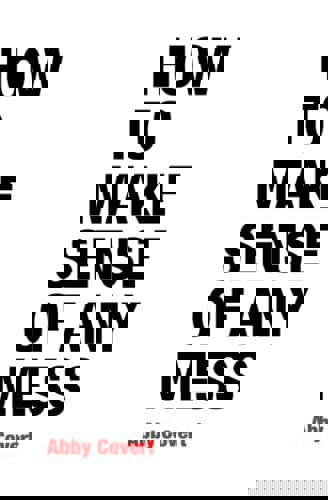
I’m not totally sure what to make of this book. I’ll probably let it sit for a few weeks then read it again.
Although, “read” is an odd word to describe it, because the presentation is non-traditional. There are seven chapters, but each page is its own self-contained thought with its own heading. No thought spans more than one page, and no page would take you more than 30 seconds or so to read.
I liked this format. It’s super-approachable.
(It kind of reminded me of Why you need a content team and how to build one.)
The seven chapters are (emphasis from the author):
- Identify the Mess
- State Your Intent
- Face Reality
- Choose a Direction
- Measure the Distance
- Play with Structure
- Prepare to Adjust
I like the flow, but this is not a practical, how-to guide. It’s very… Gestalt about the subject?. Like, the author is trying to give you the overall vibe of the process, not specific nuts and bolts. It’s not pretentious at all, but it doesn’t get down into the nitty-gritty details of anything either.
I also found interesting the variability of the term “mess.” I got the feeling that the book – which is ostensibly about information architecture – could be applied to other things, like service and process design, a speaking session to explain a topic, and perhaps even forensics and event reconstruction. There are a lot of “messes” in the world, meaning things that are hard to figure out. What constitutes a “mess” that you need to make sense of is left up to you.
There’s a very good glossary at the back (referred to as an “indexed lexicon”). Also, it introduced me to the word heterarchical which I love. It means things which are networked (at the same level, linking to each other – like Wikipedia, for example), or otherwise not possible of being represented by a strict hierarchy, or perhaps by _many hierarchies.
At one point in the first chapter, she offers some definitions of the Unholy Trinity of IA Terms: data, content, and information. She comes to some complete opposite conclusions that I did in my first book, but to be fair, I came to some opposite opinions from others. I’m not sure we’ll ever agree on how those concepts are defined or inter-relate.
Again, I’m not totally sold on the book, but apparently the author uses it as a textbook for a class she teaches, so who am I to argue with that? I feel like it’s kind of a reference-style book that you jump around in over time. I’ll keep it in my reading space for a few weeks, then run through it again.
Update
Added on
I decided to apply the principles herein to a drawer in my office which has been a dumping ground for lots of stuff. Here goes –
- Identify the Mess: It’s everything in this one drawer
- State your Intent: While I do need a place to dump random stuff, there are some sentimental things in here (cards and notes) which should be more easily accessible, and lots of things that have no utility or relevance anything; I basically need to prune it
- Face Reality: I have shamefully used this drawer to avoid dealing with things
- Choose a Direction: I’m going to extract all the sentimental cards and notes from this drawer – and other places, I have decided – and move them to a photo box, or some other, better repository
- Measure the Distance: Well, first I need the photo box, which I don’t have. I measured some of the cards in the drawer to figure out the right size, and the biggest task will be going out and buying that box
- Play with Structure: Sne structure will be the serialized box of cards; another one will be the garbage can where I throw things I don’t want or need anymore
- Prepare to Adjust: I realize this is a temporary, repeatable process; my “adjustment” will be the next time I do this
Book Info
- Author
- Abby Covert
- Year
- Pages
- 174
- Acquired
- I have read this book. According to my records, I completed it on .
- A softcover copy of this book is currently in my home library.