Red Storm Rising
TLDR: “A military masterpiece”
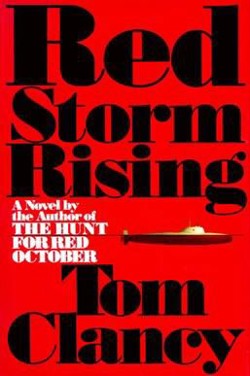
I read this book in high school, 40 years ago. For some unknown reason, I picked it up again. It was every bit as good.
In 1985, Muslim militants sabotage and destroy an oil refinery in central Russia. This causes a looming crisis as the Soviet Union will face fuel shortages for years before it can recover. Some members of the Politboro come up with a plan to seize Middle Eastern oil fields.
However, to do that, there is the small problem of NATO. Since they know NATO will defend in the Middle East, first they have to “split” NATO. They decide to do this by (1) invading West Germany by land, and (2) taking over Iceland which will give them the ability to shut down the Atlantic to resupply convoys.
The book is the story of what happens next.
It’s told from several perspectives. On the NATO side, we have the commander of an anti-sub frigate, a weatherman who escaped the Iceland base and is hiding out in the hills, a commander of a submarine, etc. On the Soviet side, we have the tank commander in Germany, the leader of the Iceland force, and others.
The book jumps back and forth between people and situations. Every chapter usually provides an update on all the main characters.
A lot of the war hinges on the Atlantic. If NATO can be supplied from the United States, then it will survive. So there are long, cat-and-mouse games between the supply convoys, their escorts, and the Soviet subs. This might be the books only weakness, as some of this got hard to follow. Sub warfare is pretty abstract as it is – you can’t see anything underwater – and reading about battle after battle got a little confusing.
It helped me to look up the geographic locations that were mentioned. Their relative locations matter to the plot, so knowing where they are relative to each other is helpful. (There are some interactive and static maps published. Here’s one example.)
There’s a lot of military terminology. I kept my phone handy to search for various acronyms and references. Clancy just assumes you know what everything is.
A few notes on character naming:
Two of the Russian officers have very similar names, both starting with “A.” It’s easy to get them confused.
Two of the characters are father and son, and therefore share the same last name. I got these two characters confused too.
Some characters are occasionally referred to by their title, or an acronym of their title (“CINC-WEST” for “Commander in Chief, Western Forces”). Make sure you can correlate these titles to the right character.
(This reminded me of all the problems I had with Russian naming in War and Peace. At least in this one you don’t have the female “-ova” suffix to worry about. Considering the name, geography, and terminology issues, having a notebook handy while reading wouldn’t be a bad idea.)
Clancy does a great job of explaining massive movements of men and machines, but also zeroing in on the human element. He centers the story around the characters and what they’re going through.
It’s a great book – the action never lets up. There’s not a dull moment in the 700 pages.
Book Data
- Author
- Tom Clancy
- Year
- Pages
- 652
- Acquired
- Not recorded
- Open Library
- OL159642W
- Wikipedia
- Red_Storm_Rising
- I have read this book. According to my records, I completed it on .
- A hardcover copy of this book is currently in my home library.