In the Beginning Was Information: A Scientist Explains the Incredible Design in Nature
TLDR: “Intereting premise, but stretches too far in the end”
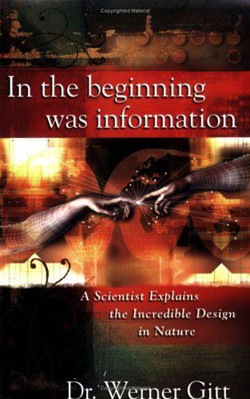
So, this is actually a reread, even though I didn’t have any notes from back when I read it for the first time (probably in 2010 or so?). I do remember this was recommended to me by a guy I sat next to on a plane. He was reading the Bible, and we got into a discussion about that, then realized we were both in IT, and he recommended this book.
I reread the book because I was hoping I would get some amazing insight from it that I missed the first time, but the basic message is the same: it’s an attempt to prove the existence of God via Claude Shannon’s information theory.
The author – who is a German mathematician, and Young Earth Creationist – goes deep into examining Shannon’s theories, to prove a seemingly simple point: the transmission of “information” requires an intelligent sender. Meaning, the formation of information requires that a being with a thought process was able to form the message and transmit it, otherwise everything is just gibberish.
I’m onboard so far, and I don’t think this is disputed much in science.
However, the author then extends this to say that DNA is the “original information” of the world. It fits all the criteria for information, and it – by definition – existed before Man did, therefore we must accept that the creation of Man was via information (hence the title of the book), and this requires us to accept an intelligent designer.
I actually like the theory. But the author makes a massive tonal shift in the third part of the book when he attempts to prove that all this validates the Bible. That’s an illogical extension of his core theory I think: he goes from proving that some intelligent designer existed, to saying that the Hebrew Bible is therefore valid. I just don’t think his central theory – which, again, I rather like – supports this.
I’ve often thought there are different “levels” in someone’s journey of faith. They kind of go like this, using myself and my current faith position as a destination.
- Atheist: “There is nothing”
- Agnostic: “I don’t know if there’s anything”
- Supernaturalist: “There’s… something”
- Theist: “There’s… someone(s)”
- Monotheist: “There’s a single someone”
- Christian/Jew: “There is the God of the Hebrew Bible”
- Protestant: “Martin Luther was right! The Pope is bad!”
- Baptist: …I have no idea; I think it has something to do with adult Baptism by immersion
- Converge Baptist: …no idea about this either
If you accept what this author is saying, that takes you from #1 to… #4? Maybe #5? His argument really has no relevance beyond that.
Outside of the third part, the book is actually a really good discussion of information theory in general. And his central point about an intelligent designer proven by the existence of information is thought-provoking. It’s not an unassailable point, by any means, but it’s interesting.
So, there are three logical parts to this book:
- Information theory in general, which is good
- DNA as an attempt to prove the existence of a Creator through information theory, which is novel and interesting
- DNA as an attempt to prove the validity of Christianity and the Hebrew Bible, which is highly questionable
So, the third part is a big leap, and I’m just not sure the prior portions of the book support it. Does it ruin everything that went before it? No, I don’t think so. The parts leading up to that are absolutely worth reading.
Book Data
- Author
- Werner Gitt
- Year
- Pages
- 264
- Acquired
- Not recorded
- Open Library
- OL8614458W
- I have read this book. According to my records, I completed it on .
- A softcover copy of this book is currently in my home library.