The Death and Life of Great American Cities
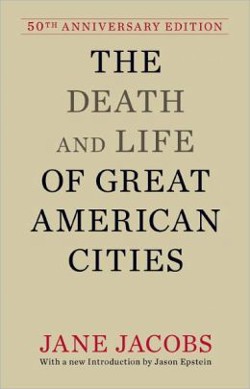
I have wanted to read this book for ages. I have a weird fascination with urban planning, and this book is held up as seminal. It’s from the 60s, and was written by the legendary Jane Jacobs.
What I find interesting about the book is where it starts: with a chapter on sidewalks. I remember thinking, “Wow, we really just dived right in there, didn’t we?” There’s little in the way of introduction, just – boom – we’re talking about sidewalks.
As the book wore on, it became apparent that we started there because, well, where else would we start? The author has so much knowledge about urban planning and the effect of design on cities, that there is ironically no good starting place. The journey of a thousand miles begins with a single step, and that step may as well have been sidewalks. She has so much information to impart, that sidewalks were as good a place as any.
The book is dense, though the writing style is deceptively breezy. She works through major issues in city planning, step-by-step. The book doesn’t feel dated, strangely.
It’s clear that she’s a New Yorker, because NYC plays heavily in most examples and chapters. She has a weird fascination with Boston’s North End too, though it’s changed considerably since the book was written.
The book has a liberal slant. There are intersections with politics and public policy, and she clearly comes down on the Democratic side of things. All throughout, it’s obvious that Jacob’s views cities as thriving milieus of clashing cultures. She’s not trying to create orderly utopias – rather, she’s trying to moderate the collision of lifestyles. How do we all live together in close proximity in such a way that it causes the least harm and strengthens our communal ties?
Reread
Added on
I read this again, because I read Messy Cities and Abundance and Paved Paradise and so the idea of collective action and city planning was kind of on my mind.
Fundamentally, the book about bottom up vs. top down planning. Jacobs believes that the only planning that works is that which acknowledges reality – what has happened and what is happening – and seeks to complement it. She’s very critical of what she calls “City Beautiful” planning (also, “Garden City” and “Radiant City”). She has a lot of criticism for the French architect Le Corbusier and his attempt to carefully plan out what he thought were beautiful cities.
Jacobs is big on “diversity,” which was also a theme of Messy Cities. She believes that a “good” city block is one that has a variety of uses which keeps people moving around at all hours. She’s very insistent that human eyes are the best deterrent to crime and other malfeasance, especially when it comes to children. She believes that lots of adults roaming around is the key to letting kids play in peace, and they get into trouble – or are the victims of trouble – when no adults are within eyesight.
She’s critical of parks, in particular. I got the feeling that she views them as attempts to force behavior on people that inevitably backfires. She doesn’t think anyone has a good reason to be in most parks, and people who are there might be up to no good.
Her goal is to keep organic human activity around as much as possible, and to this end, she criticizes new construction and idea of “urban renewal” because they tends to price a certain type of tenant out, and the resulting mix is very new and professional firms. A good block needs stores and businesses that effectively “rotate” their customers and employees around the clock.
She’s very much in favor of dense street networks. The more streets the better, because “long city blocks” or “super blocks” tend to drag down diversity and limit walking traffic.
I didn’t love this part, because I hate how cities are built around cars, not people. It got me wondering about the idea of “pedestrian streets” – could we have streets that were designed for walking traffic, not cars? How would this work? Jacobs recommends cutting up long blocks with arbitrary streets, but could we just put in a pedestrian walkway, and would this accomplish the same thing?
Jacobs notes early in the book that her guidelines only really apply to a certain type of city. When she wrote the book in 1961, she lived in Grenwich Village, and it shows. She’s really arguing for a densely residential urban environment that might not fit or work in other contexts.
What’s remarkable is that Jacobs had no training. She was an editor and journalist of architectural and planning magazines. All her work around city planning was self-taught through observation. She had no credentials, which was a common criticism of her.
However, she captured a lot of attention, both immediately and in the decades since. I can’t claim any knowledge of the actual influence she had on urban planning, but both the books I mentioned at the begining quote her, as do many others, and we’re 70 years on from its publication now.
There’s something to be said for that.
Book Data
- Author
- Jane Jacobs
- Year
- Pages
- 472
- Acquired
- Not recorded
- Open Library
- OL93641W
- Wikipedia
- The_Death_and_Life_of_Great_American_Cities
- I have read this book. According to my records, I completed it on .
- A hardcover copy of this book is currently in my home library.