Creativity, Inc.: Overcoming the Unseen Forces That Stand in the Way of True Inspiration
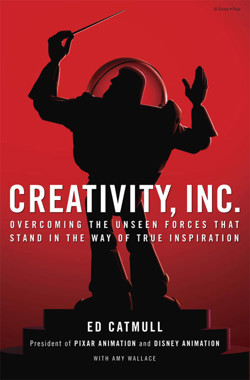
This is the story of Pixar, from one of the founders. It reads like a standard business history until the second part, where he gets into some of the specific things they did at Pixar, especially during and after the acquisition by Disney.
But, here’s the thing: how much is your business like Pixar? That’s a pretty specialized company that does some weird work. I don’t know how much would transfer anywhere else.
That said, a lot of the advice is super-evergreen, and stuff you’ve no-doubt read in other books:
- Always hire people who are smarter than you
- A good team will fix a mediocre idea, but a mediocre team will ruin a good idea
- If there’s more truth in the hallways than the meetings, you have a problem
- When hiring, give me emphasis to how much you think they can learn, rather than how much they know
- It’s not the manager’s job to prevent risks, it’s their job to make it safe to take risks (which, honestly, strikes me as the same thing, but whatever…)
So, this is a fairly mainstream business book – and that’s not a bad thing. But if you grew up with Pixar movies and you enjoy creativity, you’ll like the book. The stories are interesting, and you’ll learn a lot about what happened behind-the scenes (some of the journeys that the plots took are pretty wild).
Also, if you like Steve Jobs or Apple, then this is a great book for you. Obviously, Jobs was heavily involved with Pixar, and there are a lot of stories about him. The author even has an entire chapter at the end which refutes some of the more notorious stories about him, though the book is otherwise unsparing – it’s like at the end the author thought, “I was too hard on Steve, I need to write something nice to end it with.”
It’s a solid book about management in any industry that creates something. I work in software, and I found a lot to relate to.
Reread
Added on
I re-read this at the same time I was going back through How to Read a Book with a friend. That book got me thinking about this book in a different way.
The crux of How to Read a Book is to first figure out what a book is about – grasp the “gestalt” of it. What was the author trying to say? What was their goal in writing the book?
In my view, this book has two goals:
It’s a history of Pixar by Ed Catmull, one of the leaders who was there at the beginning. I think Catmull wanted to make sure that story got told. (He was 70-ish when he wrote the book; he’s 80 now, as I’m writing this.)
It’s an advice guide on how to maintain creativity in the face of big business. Clearly, Pixar is wildly creative, but they’re also subjected to huge market forces. How do they prevent that from stealing their creative spark?
The two goals for Catmull are intertwined. Throughout the book, he uses the history of Pixar to teach lessons about mixing creativity and business.
In talking with my friend about How to Read a Book, I hit upon something important: whenever you read a book, you have to decide why you are reading that book. Do you have a goal for the book? How do you want to be changed from reading this book? In some ways, that’s all that matters – different people might interpret a book different ways, and knowing your goal for a book will flavor how you approach and absorb it.
For me, I read Creativity Inc. because I like the joy of creation. I’m a maker, in some respects (though, digitally and with the written word, rather than physically). The idea of an organization being able to stay true to their creative urges while being a large business concern is interesting to me. I lump creativity in the same bucket as general business innovation, and so being creative is a way that organizations get better.
So, clearly, my goals aligned with #2 above. As for #1 – that’s not uninteresting, but I’m not hoping to absorb much of it. I don’t want to be able to extemporaneously quote the history of Pixar or anything.
In reading my review above, from four years ago, I’m perhaps a little saddened, because I don’t remember any of those lessons specifically. I do think I internalized quite a few of them, though – the ones about a great team and mediocre ideas, and the one about hiring smarter people than you – I’ve heard those in other places, of course (the one about a good team was in Trillion Dollar Coach which I re-read about a month ago).
And this got me thinking that the effect of some books might just be to reinforce the value of a principle. The point about hiring people smarter than yourself – I’ve heard that in countless places, and I’ve internalized that. I’m tempted to say that hearing it yet again was just wasted on me… but was it? Current Deane talks about that principle as if it’s settled fact, and maybe I feel that way because I keep encountering it?
If a book says nothing new, but just reinforces things you already knew, can you draw value from that, without even knowing it? Would you act on that principle more assertively and reflexively, given that so many things you’ve read have endorsed it?
If one person tells you that Bob is a great guy, you might forget that. But if seemingly everyone you meet is always raving about how great of a guy Bob is, then would you treat Bob differently? If meeting him for the first time, would you interact with and respond to him differently? I think you would.
Something else I’m doing when I re-read books these days is to mark them up: sometimes with a highlighter, sometimes with a pencil (I’m actively experimenting on what works best for me). But every time I finish a chapter, I’m going back through my highlights and asking myself, “What was this chapter about? Was was the gestalt of it? What was the author trying to say here?”
Something I’ve learned: some authors are better than others at this. A lot of authors are confusing and poorly organized. Others are very intellectually strict. It’s liberating to be able to consider an author’s work and say to yourself, “I’m not dumb, that was just poorly organized.”
As for this book… it’s okay. There’s a common thread throughout (which I’ll talk about later), but the intertwining of #1 and #2 from above sometimes makes it confusing what Catmull talking about at any given time. Did he include a specific anecdote just because he wanted to tell that story (#1), or is there some larger business principle I should see here (#2)?
I get the feeling that Catmull just starting writing and would drop a lesson in whenever he thought of one based on the point in history he was at. I think he could have used a good editor, but the first question an editor would have asked is, “are you writing a book of history or a book of advice” and I don’t know what Catmull would have said.
Here are the chapters of this book and what I think Catmull was trying to say in each (near as I can tell, based solely on my markup, as I page back through the book):
Introduction: Lost and Found
He foreshadows a lot of what he’ll talk about in the upcoming chapters. But he mainly sets the stage that he’s going to talk about creativity, and balancing that with business.
1. Animated
A lot of this was his personal history – he had a full-blown career in the early stages of computer animation before starting Pixar. He makes the point that management is complex.
2. Pixar is Born
More history, this time about the beginnings of Pixar. In this chapter, he first touches the idea of hiring people who are smarter than yourself, and my highlights, taken collectively, outline some notion of the advantages of setting ego aside – not micromanaging, being able to admit when someone is better than you at something, etc.
3. A Defining Goal
Some more history of Pixar, and how it almost went broke (they started off trying to sell animation hardware), and more on the points about setting yourself aside and letting your employees manage themselves. The “defining goal” of the chapter title refers to what had been Catmull’s personal defining goal of starting a computer animation company. As it turns out, he was less interested in running one, day-to-day.
4. Establishing Pixar’s Identity
Lots more history of Pixar here. This is the place where he articulates the idea of getting the team right – that’s more important than the idea. Find good people, respect them, protect them, and let them loose to do great things.
5. Honesty and Candor
This is one of the first chapters that’s not centered around Pixar history. It’s about how to get people to tell the truth – or at least, be honest when the temptation is to not upset anyone. He mentions The Braintrust, which is a Pixar institution, and gives some ideas who how to give and receive feedback. One of the keys to the success of The Braintrust, he says, is that it has no authority. It just gives advice, rather than making commands.
6. Fear and Failure
Again, this chapter is more about advice than history. He talks about the fear of making art and innovating, and how it’s basically centered around how we’re afraid to fail. And our feelings about failure are heavily drive by how our organization reacts to it. He encourages the reader to “let the mistakes happen, and let people fix them.”
7. The Hungry Beast and The Ugly Baby
This chapter gets to the core of the book. The “hungry beast” is business itself – Disney wants more and more movies, more and more profit. The “ugly baby” are new ideas, before they’ve been refined to be any good. We need to “protect the new,” which means preventing what will ultimately be good ideas from getting killed when they’re still unrefined. He states that the people who manage “the beast” are generally more organized than the people who birth the “ugly babies,” and that creates a power imbalance.
8. Change and Randomness
This is about how to manage change and deal with randomness… I think? It’s a little unfocused. People fear change, stick with what they know, and are not prepared for “black swan” events.
9. The Hidden
This chapter talks about constantly trying to find what’s hidden. In particular, you need identify your blind spots, and keep pressing further into what you think you know, to find what might be lurking below. Specifically, we careful of reporting structures that blind you to this. There is always “the hidden,” and the more you know about it, the better.
10: Broadening Our View
This chapter was a different format than the rest. Catmull specifically broke the chapter down into sections of advice. It feels like he just had a bunch of extra stuff he had to throw somewhere.
Dalies, or Solving Problems Together: Make sure your group is comfortable enough with each other to show the good and bad. This is fundamentally about “psychological safety.”
Research Trips: Do original research about things, rather than just depending on what others have told you or what you’ve seen before.
The Power of Limits: It’s okay to put reasonable limits around creative expression, just to ensure that the work gets done.
Integrating Technology and Art: Don’t shy away from new techniques and technology. Use them as a springboard to be more creative,
Short Experiments: Do small projects to both test ideas and to train people.
Learning to See: Offer education and training in different disciplines to help employees learn to set aside preconceptions and see things from different angles.
Postmortems: General advice for doing postmortem reviews well and without conflict.
Continuing to Learn: Keep yourself open to new experiences, even ones that don’t make a lot of sense on the surface, so you learn to think more openly (this seemed very similar to #6).
11. The Unmade Future
This chapter makes the point that creativity in the face of business pressure takes risk. You need to balance a lot of forces, and not flinch. And creative people have enough grit to stay in this precarious position long enough to make great things.
12. A New Challenge
Back to Pixar history. This was largely about the sale of Pixar to Disney, and the challenge of taking over Disney Animation and diagnosing it. In a lot of ways, this is a case study of a lot of the other things Catmull talked about to this point in the point. In some senses, Disney Animation was the living, breathing example of all the things Catmull was suggesting.
13: Notes Day
This entire chapter is a case study of a single called they called “Notes Day” where the entire company met and worked through process issues. I think it’s meant as an example of how companies and solicit and act on change.
The last chapter is a little bio of Steve Jobs. The book – or at least this “expanded edition” – was written just after he died. But I have little to no interest in Steve Jobs, so I didn’t read this. (I don’t think I read it the first time either.)
So, from all that, what did I learn?
I could list things here, but I’m going to be so bold as to channel Ed Catmull and say that if you asked him straight out what the entire message of the book was, he would say:
It is possible to balance creativity and business. But you have to hire smart people, empower them, and trust them to get the work done. This can be scary, and you have to be very honest with people, and honest with yourself about what you’re doing right and wrong.
That’s it. That’s really the entire message – that was Ed Catmull’s goal for writing the book.
In the end, did I learn more the second time I read at than the first time? After all, if you look way up at the top of this page, I had a similar list of lessons from my first reading.
I’m not sure. There’s the question of whether I learned more, or maybe retained it better. Did I become more… intimate, with the lessons? Will they stick in my head better? When confronted with a situation to which one of the lessons will apply, will I do something differently?
Let’s consider for a second what has to happen for us to proactively and consciously modify our behavior because of some bit of knowledge we have consumed.
- We have to be exposed to it
- We have to have understood it correctly (or, at least understood it in some manner; doing it wrong is still doing something)
- We have to acknowledge – in the moment – that this is something we could use to alter our behavior
- We have to retain it
- We have to be looking for situations where it might apply
- We have to have the initiative, resolve, and – dare I say it – bravery to apply it, rather than doing what we would have done otherwise
- We have to be able to decide if this was worthwhile or not
- We have to keep repeating 4-7 for a period of time until this becomes “the new normal”
That’s a lot.
On the other hand, even if I don’t do any of the above, have I been somehow changed by this book? Even if I don’t keep a list of “lessons that I might apply” handy at all times, what did the book mean to me? What was the large-scale, gestalt-ish insight I got from it, in whole?
In many ways, the book was just reinforcement of a lot of things I already knew (note: things I knew, not necessarily things I’m good at acting on – those are very different domains).
More than anything, however, I think the book gave me confidence that “creativity at scale” is possible. It takes work and dedication, but you can keep an organization creative and innovative and protective of “ugly babies” while successfully feeding the “hungry beast.”
In this sense, perhaps the book was more inspirational than practical? And did I know or sense this? Did I read it because I wanted to be inspired?
When I look back at specifics, these points jump out –
- Hire smart people
- Don’t micromanage them
- Set yourself aside; your own insecurities can be a problem
- Always look for what’s hidden
- Give people a safe environment in which to fail
- Examine successes and failures carefully for lessons to be learned.
Am I better off for being exposed to these lessons again? I think so.
Will I better at my job and my life because one of them might have stuck itself in my subconscious and might surface later – either consciously or subconsciously – and subtly shift my behavior like the gravitational influence of a distant planet changes the angle of a speeding asteroid ever so slightly?
There’s no way to know. I hope so, at any rate.
Book Data
- Author
- Ed Catmull
- Year
- Pages
- 368
- Acquired
- Not recorded
- Open Library
- OL17078912W
- Wikipedia
- Creativity,_Inc.
- I have read this book. According to my records, I completed it on .
- A hardcover copy of this book is currently in my home library.