The Case for Christian Nationalism
TLDR: “A very long inflammatory opinion that assumes your agreement”
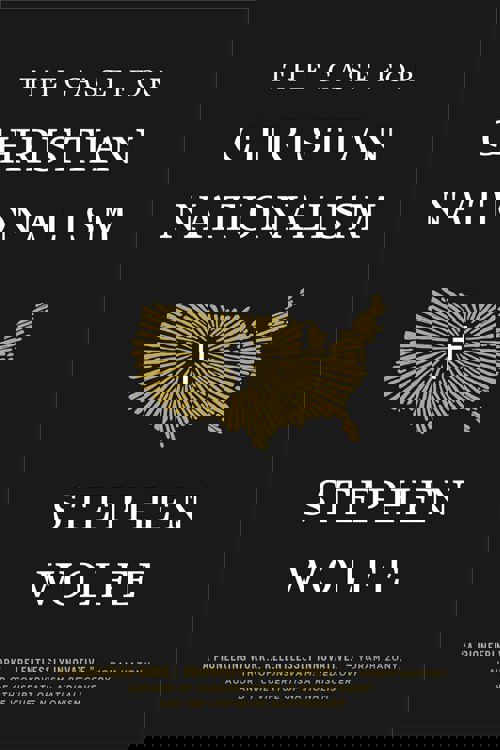
This book was wildly controversial, for good reason. The author – Stephen Wolfe – is unapologetically pushing for a very unpopular point-of-view in the current social and political climate.
Here is his argument:
- Christianity is the only true religion
- Government exists to encourage citizens to live a good life
- Therefore, the United States government should explicitly endorse and promote Christianity, and suppress other religions
(Note: I didn’t read this because I agree with this, or because I’m even predisposed to it. I read it to try and understand it.)
Understand that my analysis above is not an exaggeration or an interpretation. That is literally the argument.
Here are some quotes:
Christian nationalism is a Christian nation acting to secure and protect itself as a distinct Christian people… it follows that civil government can and ought to direct the people to the Christian religion
And:
[The military…] can be designated “soliders of Christ.”
And:
National uniformity in sacred ceremonies will certainly contribute to national solidarity. What better way for a people to image their Christian community than for all to worship the same way?
And:
Arch-heretics are publicly persistent in their damnable error and actively seek to convince others of this error, to subvert the established church, to denounce its ministers, or to instigate rebellion against magistrates. For these reasons, they can be justly put to death.
…whoa.
And:
Here, I will justify violent revolution…
(Believe me, by the time he gets to that, you’ve seen it coming a mile away.)
You have to give Wolfe credit: he’s not hiding anything. He’s openly arguing for a Christian theocracy in America, full stop. You could take the Taliban, switch out the beliefs, and I’m not sure there would be much difference.
Wolfe assumes a Reformed Christian position, and doesn’t quote the Bible much or make an argument for the right-ness of Christianity. He states outright that he simply assumes you share his religious position.
Now, I could write a lot about that, but it seems beside the point. Wolfe clearly wrote the book to express his point-of-view, and I quite suspect that he simply wouldn’t care much about arguments to the contrary. If someone pointed out not everyone agrees Christianity is the true religion, he’d likely respond, “Well, they are mistaken” and that’d be the end of that.
Thus, if you’re not a Christian, the book is simply a non-starter. That’s the first bar you have to get over.
If you’re a Libertarian, it’s also a non-starter. To agree with Wolfe, you have to renounce any claim to or belief in religious liberty.
If you’re a more traditional conservative, the book might put you in a difficult spot. You may believe the government is predisposed against Christianity and that maybe it should back off a little. But if you’re in favor of smaller government… well, this ain’t it. This is an argument for the ultimate form of “Big Government” (note my prior comments about the Taliban…)
In making his point, Wolfe relies on a claim that I’ve read in a couple of other books about Christian Nationalism. They claim that the Establishment Clause of the Bill of Rights –
Congress shall make no law respecting an establishment of religion, or prohibiting the free exercise thereof…
– was intended to apply only to the federal government. The states are free to do what they want, and several of them had pro-Christian positions written explicitly into their Constitutions.
(See Christian Nationalism and The Boniface Option.)
This position has absolutely zero chance of surviving a court challenge, so the book is largely theoretical. He’s arguing in favor of a theory – spinning a fantasy of what he would like to happen, basically.
In some sense, I think he’s simply daring Christians to disagree? He’s purposefully taking an extreme position that he knows will alienate a lot of Christians, and he’s doing so to make them think about why they disagree.
This verse was quoted in another book:
Therefore go and make disciples of all nations, baptizing them in the name of the Father and of the Son and of the Holy Spirit, 20 and teaching them to obey everything I have commanded you. – Matthew 28:19-20
That book – I think it was Isker and Torba’s book – also said this (paraphrased):
A Christian who is against government promotion and enforcement of Christianity is simply a disobedient Christian.
And that’s what this book forced me to confront. I am a Christian, but in no way do I want the U.S. government endorsing or enforcing Christianity.
The question becomes… why do I feel this way?
For me, it’s a matter of authenticity. A coerced belief is worse than no belief at all. The only true value of belief is that it’s genuine.
Wolfe concedes that the person has to make a personal choice which cannot be forced, but he believes that the government and the country as a whole should make Christianity the default expectation, because this will help people make what he feels right decision. It will “orient people to Christ.”
Is this true? I don’t share that opinion, but I’m a little conflicted as to why.
I feel like faith has value for existing in spite of the world we live in, not because of it, but I also feel like there’s another argument lurking below the surface that I can’t quite put my finger on.
It might get back to the classic argument of dealing with a problem at the source, or just dealing with the symptom of that problem.
I think about gun control laws, for example. The classic conservative opinion is that “guns don’t kill people; people kill people,” meaning that gun control is just an attempt to wallpaper over larger societal issues. However, when it comes to abortion, someone who is pro-life is quite ready to make it illegal rather than say “abortions don’t kill babies; mothers kill babies” and deal with the deeper societal problems that cause mothers to want abortions in the first place.
So, which is it? Do we deal with the underlying reasons why people don’t want to turn their lives toward Christ, or do we simply implement force and coercion in an attempt to get them there?
In countering my fear of potential hypocrisy, Wolfe makes a startling claim: you might want to murder someone, but you don’t because it’s illegal. Doesn’t that also make you a hypocrite? If only a law prevents you from doing something, then you’re a hypocrite in the sense that you would do the thing if there was no law. You’re just pretending to be a law-abiding person. So how is the inverse any different?
(Back to the prior example: do gun control laws make us hypocrites? How about restricting abortion?)
…I don’t know. I don’t have a refined enough opinion of that, but I’ll give him credit that it’s an argument I’ve never heard before.
Along the way, Wolfe makes a handful of other claims –
Christians are capitulating to their own persecution, rather than fighting. In some cases, Christians get a “persecution fetish” (my words, but there’s also a subreddit for it) where hostility to Christianity is viewed as a good thing, perhaps in some parallel to how Jesus was treated.
“Particularity” is good. We should be oriented towards our own people, and prefer them to others. Cultural diversity causes conflict, and weakens cultural expectations. (In saying this, I don’t get the feeling that Wolfe is explicitly racist. He’s fine with other races, so long as they stay where they’re at. …of course, he might be assuming something about the racial makeup and “default race” of the United States, I suppose.)
Men have been feminized and a “gynocracy” runs the country. Even if woman aren’t actually running the country, the men who are have compromised their leadership in a concession to maternal influence about nurturing and conflict resolution. (He succumbs a bit to the “alpha male” thing here…)
The nation needs to embrace (or return to) “cultural Christianity,” meaning that Christianity should be considered the default societal expectation, and other religions (or no religion at all) should be ostracized (basically, you can believe what you want, but if it’s not Christianity, you don’t discuss it). He references Renn’s claim to a “Negative World” for Christianity (which I agree with).
If Christian Nationalism is not an option, Christians should self-segregate, try to only do business with other like-minded Christians, and concentrate on things like homesteading, “martial” (note: not marital – martial, like violence; stay in shape and learn to fight) skills, and self-sufficiency
I get particularly annoyed at that last one. How is that helpful? How is hiding in the woods going to help us “make disciples of all nations”? (Isker and Torba were big on “parallel societies” as well.)
The book is well-written. Wolfe states his case unapologetically and calmly backs it up, regardless of whether or not you believe any of it. Only at the end (in an epilogue entitled “Now What?”) does he retreat into well-worn Right-wing tropes and name-calling (“coastal elites,” and such).
I don’t agree with the book. But it did make me think.
I have a (very) grudging respect for how unapologetic and open Wolfe is. He doesn’t beat around the bush – he simply assumes you agree with his religious position and moves on. And he doesn’t ease you into his argument. He’s completely upfront about everything, and that was refreshing from a rhetorical perspective.
In saying the quiet part out loud and daring the reader to disagree, Wolfe put me in a position to examine my own beliefs critically. I feel like I haven’t done this to near the degree I need to, and the book is going to bounce around in my head for a while.
For that, if nothing else, I am (maybe) a little grateful.
Book Data
- Author
- Stephen Wolfe
- Year
- Pages
- 475
- Acquired
- Not recorded
- Open Library
- OL29231480W
- Wikipedia
- The_Case_for_Christian_Nationalism
- I have read this book. According to my records, I completed it on .
- A softcover copy of this book is currently in my home library.