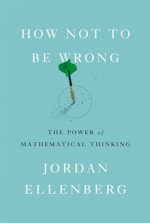
“This is a weird one. It’s basically 100 vignettes, theoretically how math and art intersect. But…it didn’t always hit right. I skipped around quite a bit – the book really invites that. Here’s some examples: A discussion of how many guards an art gallery might need if it was shaped a specific way….”
“ Arabic Numbers are the common, base-10 numeric system most people in the world use: 0, 1, 2, 3, 4, 5, 6, 7, 8, 9. They’re not from Arabia specifically, but they were brought to Spain in the 900s by Arabic speakers from North Africa across the Straight of Gibraltar. ”
“Thomas Bayes was a 17th century English polymath. He documented a method for statistical analysis and probability which has become core to those disciplines. In its simplest form, Bayes Theorem allows us to find the probability of an event occurring them we know the probability of multiple related…”
“wonderful book. presents a wire-ranging looking at the big data phenomenon, specifically on the technological and societal changes that have occurred to bring it about, and what this means to the future. things like: Our sample sizes are increasing. For many applications, we’re able to poll n =…”
“This is a computer programming term. It refers to operations that are performed on sequences of bits, in aggregate. A byte is made up of eight bits, which can be 0 or 1. So a byte might look like this: 00011011 A bitstring (or bitpattern) is any sequence of bits – not necessarily an entire byte. A…”
“Calculus is the hard substance that plaque turns into if it’s not removed – otherwise known as ‘tartar.’ This is the stuff that the dental hygenist is scraping off your teeth during your visit. It can also refer to a hard mass of some kind, often one in the kidney or the bladder. The name comes…”
“In general, this refers to something that can be linked back to Rene Descartes, the French scientist, famous for uttering the phrase, ‘I think, therefore I am.’ There are several scientific, mathematical, and philosophical branches that are named for Descartes: Cartesian geometry Cartesian…”
“A look at the profound-ness of math and why it matters. Gets a little ponderous in places, but it’s a wonderful examination of eternal rules of math which transcend numbers to logic and even philosophy. In some parts, it examines rules of logical thinking. In others, it examines how academia treats…”
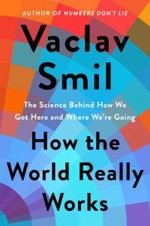
“The author is a physicist, and he attempts to explain how the world really works, meaning what’s is utterly necessary for humans to survive as a species. For example, he explains why we need ammonia. Because we use it to make fertilizer ever since the Haber-Bosch process was established, and…”
“Not what I expected. I thought I was getting a technical book with literal strategies for managing and migrating legacy systems. Instead, the book spends a lot of time on organizational politics, change planning, and even developer psychology. I’m not saying this is wrong (the author clearly knows…”
“Lovely biography of Claude Shannon, who gave us information/communication theory. Covers his life from birth to death, in short chapters, each devoted to some aspect or time period. The longest chapter is a discussion of ‘A Mathematical Basis for Communication,’ and is one of the best summaries…”
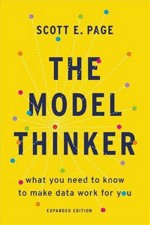
“This is literally a textbook – the author says much at the beginning. He’s a professor at the University of Michigan, and he writes about how a friend asked him to resurrect a course on statistical modeling. That course became this book. Models are ways of thinking and analyzing a subject. It’s a…”
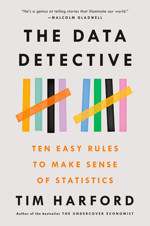
“A genuinely wonderful book. Extremely readable, very informative. He does a nice job of putting statistics in context, particularly around how they can be used to manipulate questions by simply framing issues differently. I’m normally skeptical of ‘For Dummies’ style books that try to simplify…”
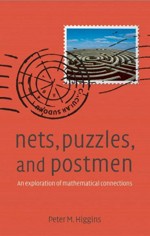
“Technically, I abandoned this book, but I’m still counting it as read because I learned a lot from it. What I learned is that network theory is actually a thing. It’s a branch of mathematics. And, weirdly, a lot of the seemingly unsolvable story problems you read as a kid are actually network…”
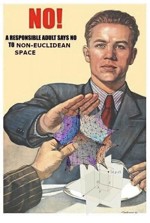
“‘Non-Euclidean Geometry’ is the field of geometry as applied to non-flat surfaces and non-straight lines. Euclid was an ancient mathematician who published a work called The Elements . This laid out the basic, common principles of geometry that we know today. However, Euclid only dealt with flat,…”
“Throughout this book, the author keeps trying to make the phrase ‘Super Cruncher/ing/ed’ happen. I kept thinking back to the character in Mean Girls that said, ‘Gretchen, stop trying to make ‘fetch’ happen. It’s not going to happen.’ It gets distracting. And annoying. It doesn’t help that it sounds…”