My Tiny Life: Crime and Passion in a Virtual World
TLDR: “Slightly ponderous, but interesting”
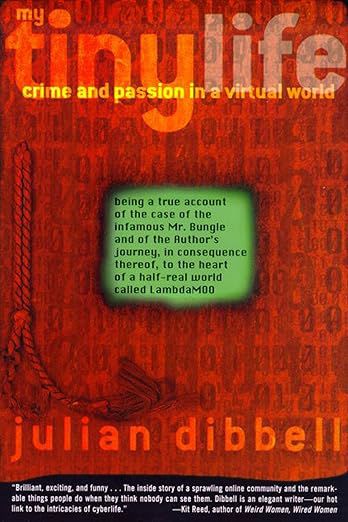
This is the story of a journalist’s experience with LambdaMOO, which was the original “chat room” of the early 1990s.
A couple definitions –
- A “MUD” was a “Multi-User Dungeon,” which was original a game-ish environment where you could move through a virtual space, described via text only.
- A “MOO” was a “(MUD) object-oriented,” which referred to a specific new method of technology and design of the original MUDs, but generally came to mean nothing more than a more advanced MUD.
LambdaMOO was one of the original MOOs, originally founded at Xerox PARC. The author is a journalist who connects to the environment in the 1990s. He originally wrote a story called “A Rape in Cyberspace” on the cover of the Village Voice in 1998 which detailed a specific event that happened in the MOO. A player hacked the system to force the virtual avatars of other players to engage in (and describe) sexual acts performed on his avatar.
The fallout from this event, and the journalist’s subsequent adventures on the MOO turned into this book.
Fundamentally, the book is about how we were all adapting to online life in the 1990s. It’s about the projection of our corporeal selves into virtual analogs, and how that affects us psychologically.
Are we our virtual selves? Do our actions as our virtual selves reflect our real selves? Does an act performed virtually (the aforementioned “rape,” for example) carry the same weight as if performed physically?
The writing style is very dramatic. The book reads kind of a like a novel, or a memoir. The journalist often compares and contrasts his adventures on the MOO with his relationship with his real-world girlfriend, and the idea of love, emotion, and sexual experience weigh pretty heavily on everything.
The author spends a lot of time talking about “cybersex” (quoted, because there’s no settled definition of it). There’s a section where the author is determined to participate in cybersex, and has a debate with his girlfriend about whether or not it’s real sex and would constitute cheating. At some point, I believe he does go through with the act, but I skipped the last half of that chapter because it got cringey and really didn’t want to read about it.
I’m fascinated by the history of technology, and specifically how humans have adapted to it. In this respect, the book is a good look at back when we were on the cusp of a revolution. In the late 90s, we were all moving swiftly online, and we were trying to figure out the relationship between our digital lives and our real lives, and wrestling with the confusion this brought about.
So, I enjoyed that part of it. As a whole, however, the book can be a bit of a tedious read. It’s very memoir-ish, so it’s left to the reader to decide what – if anything – is to be learned from the experience.
Book Info
- Author
- Julian Dibbell
- Year
- Pages
- 352
- Acquired
- I have read this book. According to my records, I completed it on .
- A softcover copy of this book is currently in my home library.