The Only Plane in the Sky: An Oral History of 9/11
TLDR: “An amazing experience you will never forget”
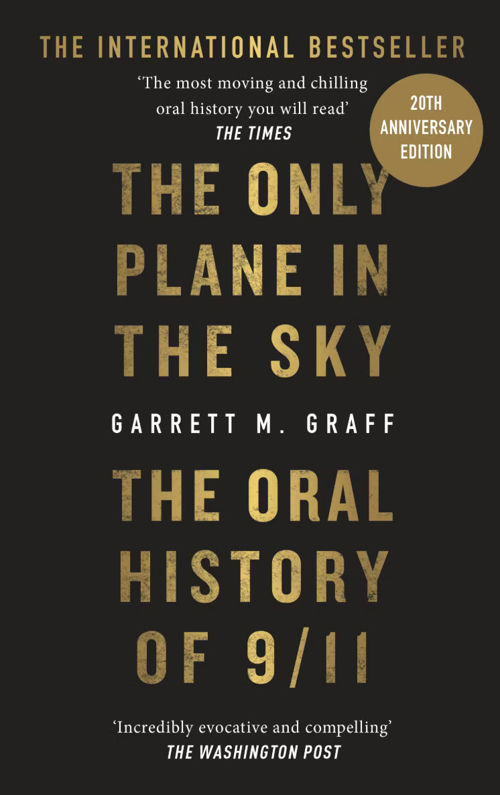
This was an amazing…experience. I call it that because I listened to this book on audio during a long road trip. I loved it so much that I ordered the hardcover before I even got home.
The audio version is read by a multi-voice cast of almost 50 voice actors. They need to do this because the book is a literal oral history – it’s a thousand (two thousand? three?) little vignettes of the 24 hours after the first 9/11 plane took off from Boston, told in the first person.
It goes through the day in chronological order, step by step, minute by minute, telling the stories by the people who lived through it. There are hundreds and hundreds of individual retellers. Many of them you come to know, because the story keeps coming back to them over and over again, throughout the day.
When introduced, the speakers give their name, what they were doing (like, which company they worked for), and – ominously – which floor of the towers they were on when the planes it.
The people are from all walks – some survivors, some rescue workers, some celebrities. There are stories and anecdotes from Dick Cheney, Donald Rumsfeld, Dennis Hastert, even George Bush.
This is what I believe to be the most comprehensive account of what happened on 9/11. The audio book was 16 hours long. It goes into excruciating detail, from every possible perspective. It’s a staggering work of compilation.
Some things I learned –
The biggest immediate fear was that the rescuers didn’t know if there were more hijacked planes. Until the FAA got all the planes on the ground, rescue work would stop when a plane got near, because they didn’t know which planes were weapons.
The Pentagon crash would have been much worse, except they crashed into a section of the building that had just been remodeled, and not everyone had moved back in.
Some people still in the Twin Towers survived the collapse. The building came down around them, but they managed to be in a pocket of space, like an elevator shaft. Several people were pulled out of the wreckage after the collapse.
A “shootdown” order was given, to bring down any threatening planes. There was one plane inbound from Europe that was the only plane left, and discussion was had about whether or not to intercept it, but it eventually turned back.
The President was genuinely desperate to get back to Washington, but his security wouldn’t allow it until they were sure all the planes were down. He went from Florida, where he was reading to an elementary school, to Barksdale AFB in Louisiana, then to Offut AFB in Nebraska because it had better communications. Then they flew back to Washington so fast that the fighter escorts had trouble keeping up without running out of fuel (apparently Air Force One is a very fast plane).
During the travels of Air Force One on 9/11, the Secret Service posted an armed guard at the bottom of the stairs leading to the upper deck where the president was. The implied message was, “We don’t even know for sure that a terrorist isn’t on this plane right now.”
United 93 – the plane that crashed in Pennsylvania – was delayed at takeoff. This meant that they were in the air later than planned, and the passengers had seen news reports of the other planes hitting buildings. This is why they stormed the cockpit – the passengers on the other flights had acquiesced to the hijackers, but the United 93 passengers had seen what was going to happen to them. If their plane had taken off on time, they might have stayed in their seats, and it might have hit the Capitol (where investigators believe it was headed).
The F-16s that took off to intercept United 93 were not armed. They left before they could be loaded with missiles or bullets. The pilots debated whether or not to ram the plane out of the sky, but it crashed before they intercepted it.
There is audio recording of the struggle on United 93. I do not know if this is public, but apparently there is very clear audio from the cockpit recording of the fight for control of the plane. They cannot tell if the passengers ever got in the cockpit, but the terrorists voices are heard responding to the passengers trying to get in. The last words recorded are “Allahu Akbar” repeated eight times.
When the towers collapses, dust and ash became a huge problem. People couldn’t breath. Multiple people tell of having to literally scoop gobs of ash out of their mouths so they could breath.
In the afternoon of 9/11, boats of all kinds started pulling up to docks in Lower Manhattan to ferry people across the East River and the Hudson to safety. It turned into one of the largest maritime boat lifts in history, far bigger than even Dunkirk. An estimated 500,000 people were evacuated.
The hospitals in New York braced for a massive influx of patients… that never came. They realized, to their horror, that almost everyone had died, and that there were relatively few injured to care for.
Falling bodies from the towers was a significant problem for the rescue workers. More than one firefighter was killed by a jumper landing on them.
Some of the most harrowing survival stories are people who had to make it down the stairs of one of the two towers. They descended hundreds of flights of stairs in darkness and smoke. Lots of people died on the way down. Survivors headed down were constantly being passed by firefighters heading up.
When the plane hit the North Tower, a massive fireball shot down an elevator shaft and exploded into the lobby, killing people all the way down on the ground.
Rudy Guliani happened to be in the area when the planes hit. He was a few blocks from Ground Zero for most of the day. Likewise, Donald Rumsfeld was in the Pentagon and went to the affected area to help survivors.
An American Airlines ticket agent had unwittingly helped two of the hijackers make it onto their flight. He didn’t realize what he had done until the next day. He struggled with it for years afterwards.
Lots of survivors didn’t know what to do when they got out of the towers. A lot of them just walked home across the closed bridges to New Jersey, Brooklyn, or Queens.
The last survivor at Ground Zero was rescued at about 10 a.m. on the next morning. No one else was found alive after that.
In the weeks after 9/11, tow trucks were dispatched to train stations in New Jersey to remove all the vehicles that hadn’t moved since that day. These were owned by people who never returned for them.
An older woman named Josephine was rescued from one of the towers by a group of firefighters. When she died of natural causes years later, she asked that the firefighters be her pallbearers.
A couple things in particular struck me –
There was so much bravery. There are so many stories of people running back into the buildings, and people helping other people at huge personal risk to themselves. I kept wondering: would I be that brave, if I was there?
Another theme was the sheer physicality of survival. Many people who survived went to hell and back to get out. They carried other people, they moved heavy things, they through fought dust and heat and smoke.
There are other heartbreaking stories of people in poor physical condition who didn’t make it. Bodyweight was an unavoidable factor – there are several stories of obese people who couldn’t be easily moved, or who just gave up and couldn’t go on. I kept wondering: would I survive? Would I have had the physical capacity necessary to make it out? Would I have had the tenacity to carry on?
This is just an amazing book, and a rare instance where I’m going to say: listen to it on audio. The voice acting is very well-done. Clearly, each of the actors speak multiple parts, but I didn’t start to notice that until the end.
I did not speed up the audio of this book like I usually do. I listened to every last minute of the 16 hours.
It was an incredible experience. I am a different person for having listened to it all.
Book Info
- Author
- Garrett M. Graff
- Year
- Pages
- 512
- Acquired
- I have read this book. According to my records, I completed it on .
- A hardcover copy of this book is currently in my home library.