Messy Cities: Why We Can’t Plan Everything
TLDR: “Uneven, like most anthologies”
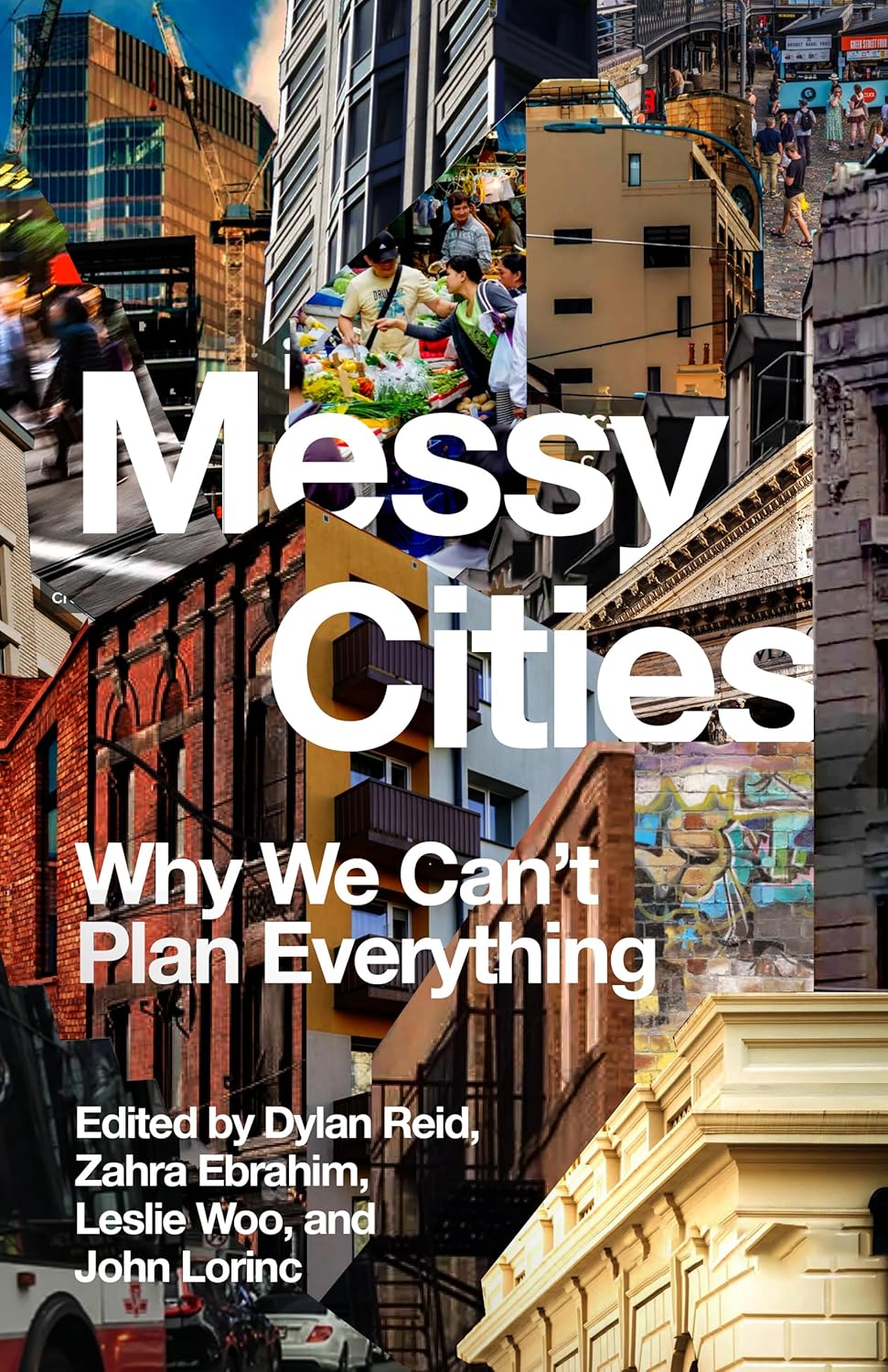
Appropriately, I started this book just after having returned from five days in New York City. I was there for a two-day conference in Brooklyn, but I stayed in Tribeca, and spent some time walking the streets of that neighborhood and Soho. Between those sojourns and the subway to Brooklyn each morning, I got pretty good dose of a “messy city.”
I’m going to document the book in real-time below. It’s an anthology, so each chapter is a self-contained essay.
Introduction
Whomever wrote the introduction started off by talking about “desire lines” or “desire paths,” which are paths worn into the ground by where people actual want to want, rather than that’s planned. I enjoyed this quote:
They are the paths we take rather than the paths we are given.
And that really sets up the entire book.
The goal of this collection is to show that messiness is an essential element of the city… Messy urbanism needs championing, because out minds and instincts tend to default to the seemingly simpler options of seeking order.
I also enjoyed a quote from an separate article about “complexity” in a city, and what it demands of us:
…learning to interact well with strangers requires a toleration of ambiguity, the capacity to contain frustration, an ability to listen carefully to people whose speech, needs, or desires may seem alien.
Reflections
A Farewell to El Gran Burrito
This is an elegy for a Mexican street vendor in Los Angeles. The authors make the point that it was in a crappy building, but the food was amazing. The authors relate a story of visiting in the wee hours of the morning and being amazed by the cross-section of the people who were there – with an emphasis on the local queer community.
Sadly, the El Gran Burrito building got torn down to redevelop the area around it.
As urban planners and designers, we are schooled and trained to think that the best buildings and public spaces are born of grand visions framed by clean lines and filled with exquisite details.
[…] And what happens when they aesthetics get repeated as nauseum? You get a sameness in scale and look that makes cities almost indistinguishable from each other.
The authors ask how cities might avoid this sameness and codify protections for an eclectic mix of building types.
They use the word “vitality” a lot, which I suspect will come up throughout the book.
These Walls, These Roads
This is a very political essay from a Palestinian about the Israeli occupation of the land his family calls home.
His larger point seems to be that the forces that control a city can force other people into patterns of life that affect their sense of time.
How long is the bus stop wait? How long is the walk to the nearest grocery store? How many years of work until you can afford a home? How long is the co-op housing wait list? How about your commute.
He finishes with a reference to a concept called “right to the city.”
the right to full participation in the collective act of the city, the right to not only be from or belong to a place but to see yourself reflected in it and to partake in the creative act of shaping where you reside.
This essay seems a little out of place. I don’t deny the validity of the author’s experience, but I’m not sure how it relates to the purported subject of the book.
Living Loud: The Migration of a Steelpan Soundtrack
This is an essay about the noise of a city. The author was originally from Trinidad, where he was constantly subjected to noise.
He and his family immigrated to Toronto, and he discusses how the perception and toleration of noise is vastly different there.
The energy, the vibrancy, the joy of family noise has migrated to other countries and, carried miles and miles abroad, where it has not always been welcomed.
[…] It is no wonder that many from the south who venture to build new lives up north feel a chill not just of winter’s cold but of that silence.
I think his point is to promote the idea of noise as a key part of a vibrant city.
The good news is that we can live with noise. In the same was that the rhythm of our breath or our heartbeat steadies us. Noise is not a hindrance to a good life – it can propel a tidy life with a syncopation that can bridge oceans and cultures.
Planning for an Unplanned City
This is a discussion of whether we might have over-regulated cities. The author opens with a discussion of a Hanoi train that passes within inches of merchants and restaurant tables on it way out of the city, and how this would never be allowed in a Western city.
Have our rules and regulations squeezed too much of the life out of our cities? Or are they critical bulwarks for protecting public health and safety?
The author seems torn on the question. On the one hand, he wants more flexibility in how cities can respond to challenges, but on the other hand, he concedes that we need to keep people safe, and that flexibility in rules means they might be abused by people seeking to take an advantage:
Each of these, on its own, serves a valuable public purpose. In the aggregate, however, they can also preclue some of the dynamic urbansim that many cities are trying to recapture.
Interruptions
The author talks about their Toronto neighborhood, which is very dense, and how every neighbor is part of their neighbors’ lives. They borrow things from each other, know the entry codes to everyone’s house, and are constantly discussing their lives with each other.
I was recently sharing with some friends about colleagues about this resolving door of daily interruptions… They visibly recoiled at the prospect of interactions this intimate in their own living environments.
The author claims that living with this level of casual intimacy makes for better understanding between people.
There’s evidence that knowing people with vastly different lived experiences than your dramatically increased your capacity for empathy for them and others of their background. …it’s part of the social contract I think we agree to when we live in big cities.
No citation is given for that, but the other does also mention a 1995 Chicago heat wave where survival was linked to someone’s intimacy with their neighbors, which meant that groups of people would check on each other and make sure they were coping with the heat and not in distress (I assume there is some known evidence for this, though I didn’t find anything on the Wikipedia page).
The author discusses how they moved to Toronto from Vancouver, and how they believe they they were subconsciously looking for more closeness with neighbors. He cities his background in an Indian-Kenyan family, and makes a funny observation about American sitcoms like Family Matters and Full House where the neighbors (Steve Urkel and Kimmy Gibler, respectively) were always dropping in unannounced.
Packrat City
This is discussion of the author’s role as a “heritage planner” for the city of Toronto. Unfortunately, I couldn’t quite figure out what a heritage planner is. I searched for the author, and found her on v various platforms, but I still don’t have a great definition.
She starts the essay talking about how she keeps physical things that bring back memories. She calls herself a “packrat,” not a hoarder.
More recently, heritage planners have shifted toward a conversation paradigm that includes buildings not for their landmark status, but for the contextual role they play in the city. These buildings weren’t constructed to communicate nationalism, wealth, or grandeur, but they have more subtle stories to tell. The role of the heritage planner is to find those stories and determine whether and how to hold on to them.
That’s the closest I got to a definition.
Localities
An Argument Worth Having
This essay is by the head of the Chinatown Land Trust in Toronto, which is a type of organization that collectively owns land and allows members to vote on usage.
She writes that arguments and conflict are good. It means that people are engaged in the process and feel that their communities are worth arguing about and for.
I have come to believe that Chinatown’s ability to weather its storms comes from an organic level of protection – a healthy capacity for community conflict. In all its most dysfunctional and generative ways.
[…] I would pick a conflict with my co-op neighbor about who to hire for our giant plumbing contract next year over begging my landlord to let me turn on the air conditioner every summer.
Conflict means that people have skin in the game, and it implies that they want good resolutions because they need and plan to live with the consequences.
Dixie Road
This essay seemed to be a bit of a polemic against the suburbs. The author was an immigrant, and after moving to Toronto was immediately struck by how big the spaces were – how wide the streets were (hence the title), and how far away everything seemed.
The author proposes two changes:
- Greater variation in zoning requirements, allowing closer usages of land types
- A reduction in car-based regulations, such as street width, corner radii, and minimum parking requirements)
Suburbs across the country are victims of normative planning and development processes that prioritized the creation of a rapid revenue base through large-scale, rural-to-suburban land-use conversion and rigid, car-centric design standards.
A Beach Like No Other
This was essentially a story about a construction site and what a neighborhood did with it.
When a building was demolished and the ensuing construction was delayed, an empty lot appear in a neighborhood. Several people rallied around this lot, named it “Bloordale Beach” and began gathering there.
For most of the year and a half, Bloordale Beach existed as a gorgeous landlocked oasis, if not in its physical appearance, then in the community’s hearts and minds. The beach offered levity during the most difficult months of the pandemic.
The essay tells of a “Shared Space Initiative,” where Toronto designated certain spaces as “open” during the pandemic, but encouraged people to socially distance within them.
If the city would lighten up a little, like they did with the beach, and let us have some fun, who knows what other kinds of creations could emerge.
The Ballet of the Parking Lot
This is a discussion of “POPS” – Privately-Owned Publicly Accessible Space (the acronym doesn’t quite work). In particular, it’s discussing strip mall parking lots, which are private-owned, but have public uses.
The authors created a program they called “plazaPOPS” where they created more inviting spaces in these parking lots. They would install benches and tables, and invite social gatherings and public events to take place.
[The] parking lots may be unappealing, yet they anchor the city’s social life. Should strip mall plazas be considered part of the public realm?
What is Safety
This one is really out of place. It’s a discussion of an organization called Rainbow Railroad that helps LGBT people in oppressive countries immigrate to friendlier countries. The story is anchored around the suicide of a woman who attended a queer concert in Egypt and was persecuted for it.
There is very little tying this one to the topic of the book. There a few mentions of a housing crisis and how hard it is to find a place to live once you immigrate, but is essay is mainly concerned with explaining the plight of queer people in countries like Uganda and Afghanistan.
Why Can’t We Sell Stuff Anyplace?
This is… discussion (?) of zoning laws that prevent people from selling things wherever they want.
…why some cities, especially in the Global North, are so particular about where shopping can happen.
The essay discusses how shopping happens in other, less regulated, areas of the world – Hanoi, Istanbul, etc. – and then goes into a long-ish history of zoning laws and how we ended up separating business and residential areas.
In the end, other than highlighting the fact that the “Global North” tends to separate these areas, the author doesn’t seem to argue much in either direction. He seems satisfied to simply note the difference.
Desire Lines in the Sand
This essay is a discussion of Hanlan’s Point (or sometimes “Hanlan’s Beach”) in Toronto, which is an informal gathering place for the LGBT community and a generally accepted place for nudity in the city.
It discusses how the area morphed into its current use over the course of a century, which explains the “desire lines” of the title: some areas become what they are because there is a need for it among the populace, and they sort of just “claim” a space to fill the need.
For queer communities, desire lines symbolize the many ways that queer people have made places for themselves in cities that have often excluded or erased them.
The essay talks about an effort of the city to develop Hanlan’s Point into a entertainment district, and the grassroots counter-effort that sprung up to prevent the removal of a claimed area for the queer population of Toronto.
Conjay’s First Walk Home
This is a bit of fiction, about a boy named Conjay and his first day of second grade. He lives in the Toronto neighborhood of Little Jamaica.
In the story, he walks home with his friend Omar, but gets lost. However, he’s so familiar with his neighborhood – the people, the businesses, and the sights – that he’s able to find his way back.
It’s a bit cringey and utopian, but I get the point. When we go everywhere in cars, we’re insulated from landmarks and waypoints. But since Conjay lived in a neighborhood where he could walk, he was much more familiar with his surroundings.
Flexible Streets
This one is a little confusing because it starts with an anecdote about a blind woman and her dog. She is testing whether a new street configuration is navigable by the disabled. This made me think it was going to be about accessibility…
But it’s not. It’s about changing city streets to do more than just route cars. It discusses a bunch of different ways that cities have tried to get more use out of these streets: from little parks in parking spaces to Dutch streets that are considered an extension of the residents’ front lawns.
…as part of an increasing challenge to the dominance of the motorized vehicle, [the] boundaries are being blurred. Publish spaces are being reimagined and hybrid, flexible, or shared, their boundaries fuzzy and their functions bleeding into each other.
Leave the Leaves
This essay is an admonishment of the practice of cleaning up leaf waste. It makes the point that “leaf litter,” as its often called, plays an important role in the bio-chain and shouldn’t be packed up into bags and moved. It should just be left where it is.
Far from being waste, leaf little is an ecosystem – an damp, dark place of decomposition and regeneration. […] The landscape “cleaning up” choreography, timed with autumn’s arrival and repeated in the spring, is a ritual of harm. […] We’ve been trained by aesthetic conventions to view organic detritus as something that looks “messy.”
I identified with this one, quite a bit. I hate cleaning up leaves, and my wife loves how they look on the lawn. I’ll leave them as long as possible, and the only thing I’ll usually do is mulch them up in the mower. I would never bag them.
The essay was good: had a strong point and recommendation.
Non-humans (Heard and Unheard)
This one was really odd. It explained an exercise that the authors conduct in workshops (I gather that the authors are indigenous artists).
It’s a listening exercise. You are meant to listen carefully to all the sounds you hear. But has some odd angles.
For the next five minutes, do you have permission to listen? Can you remember how to hear the unheard sounds of non-humans? […] Acknowledge you are a visitor to this place, and attune to the sounds/vibrations as they enter your ears and move through/against your body.
I struggled to find anything meaningful here (I noticed that I didn’t highlight anything). However, when describing an after-exercise discussion, a participant said something interesting:
If we could only get rid of these sounds, we could have better listening.
That feels like an attempt to deny the reality of what is and replace it with the fantasy of what is desired.
My Teacher
This is a very short essay about a turtle laying her eggs, and more generally about the plight of many turtles in Toronto’s High Park and the dangers they encounter.
The lands have become a place that prioritizes human activity and often forgets the impacts of this activity on all of our animal and plant relatives.
Again, it’s very short. There’s not much of a point beyond the quote above.
Beyond the Lawn: Meadow or Mess?
This is a longer essay (the first one with subheaders) about a “pollinator habitat” front lawn that was cited by Toronto code enforcement. Unfortunately for the city, the person who maintained the habitat is a “professor of urban planning.”
The fight over this particular lawn apparently dragged on and was something of a cause celebre. The author eventually got a meeting with the mayor of Toronto about it, at which the mayor was presented with a comprehensive plan to reform the lawn to allow habitats like this. The author states that none of the reforms were ever implemented.
Interesting, the author cites a Canadian court precedent that says that the Canadian Charter of Rights and Freedoms…
…extends to protect expressions of environment values and beliefs reflected in natural gardens.
The author also calls out that laws on these situations are necessarily subjective:
A weed is simply an undesired plant, a flower growing in the wrong place.
And there’s some commentary on how traditional, manicured lawns imply something about society:
The lawn is all about order and control. Much has been written about this, along with its colonial roots. As a symbol of leisure and wealth introduced from Britain, the virtues of the clean-shaven lawn were extolled and emulated by American elites from Jefferson to Olmstead, and later, postwar, became integral to the identity of the suburban landscape. Facing the street, the front lawn signals conformity to neighborhood norms, order through homogeneity – a monoculture cut to prevent seed, its fertility controlled.
I could not determine if the author ever had to cut down their habitat.
Designing Out Disorder
This essay is about “defensive urbanism,” or the design of the built environment to discourage certain behavior. The author singles out specific things designed to prevent homeless people from using the spaces to live.
The most common forms of defensive urbanism include modified seating, unusable surfaces, spatial barriers, uncomfortable light and sound, and the absence of public amenities.
This is apparently linked to something called Crime Prevention Thought Environmental Design which is a philosophy that dates from the 1960s.
Beyond direct criticism of defensive urbanism, the author expands the perspective to the philosophical:
the purpose and meaning of public space is contested.
[…] encounters with difference are one of the defining features of urban life. Urban historian Lewis Mumford writes that the primary purpose of the city is “to permit – indeed to encourage – the greatest possible number of meeting, encounters, challenges, between varied persons and groups, providing as it were a stage upon which the drama of social life my be enacted.”
That is an opinion, clearly. The author continues to explain why this matters:
While not always comfortable, exposure to people of different ages, races, classes, religions, politics, and cultures and create conditions for mutual respect, political solidarity, tolerance, and civil discourse. […] When we use design to displace, it means hiding, rather than acknowledging, the social and political realities faced by marginalized communities and individuals.
There’s a point there. Doing things to remove homeless people from public spaces does not fix homelessness. It just prevents us from having to acknowledge it. The truth is that most of us are just fine that homelessness exists, so long as we don’t have to look at it.
The Collective Effervescence of Messy Parks
This is about how parks are meant to be a collision of lives. It very much echos the theme of the last essay:
[…] that’s part of the beauty of parks – they bring you into contact with other people, and contact sometimes leads to friction. However, it’s working through these frictions, rather than avoiding them, that strengthens communities.
The essay claims that “good” parks are ones that lots of different people use for lots of different purposes. “Overdeisnged and overregulated” parks make them less approachable and less comfortable.
Just as we tend a garden, we need to embrace the complexity of life and give our parks the right mix of resources, care, and freedom to evolve and grow into their own.
Mexico City’s Eclectic Apartment Architecture
True to the title, this essay starts out discussing the author’s trip to Mexico City and the wide variety of apartment styles he found there. Then he segues into a discussion of too much planning in city development.
The overly planned cities in Canada and the U.S. make it very challenging for builders to experiment with de elopment and learn from successes and failures.
[…] Many of the planning restrictions that define development in Toronto have been instituted for one three broad reasons: to prevent specific outcomes that the city has determined are undesirable, to protected the (assumed) needs and desires of existing residents who live near a development, or to advance arbitrary aesthetic preferences.
And this gets the to the heart of the book and the underlying problem: cities are opinions. What one person likes, another will hate, and city planning is an attempt to figure out how to balance everyone’s preferences. This author has a different preference, and would prefer the city accomodate that.
Later in the piece, he does discuss outcomes other than preferential:
Micromanaging every aspect of a proposed building as led to worse outcomes for new developments and has made it difficult to achieve thriving, successful communities with abundant housing.
One of the problems, I think, is that buildings are relatively permanent. This isn’t like allowing a temporary sidewalk sale or something. When a building is built, you’re kind of stuck with it for a long time. Does this imply we should be more conservative?
Tower Communities Are What We Make Them
This is a short essay, and a little confusing. It discusses some large tower apartment buildings in the Toronto suburb of Scarborough.
I’m not sure what the author was advocating for, other than a recollection of a place where they grew up. They tell of tightly-packed units in buildings with residential spaces repurposed for other uses, like a mosque.
Honestly, while the author seems to recall this all with some fondness, it doesn’t sound great.
Many of the apartment units housed considerably more people and the names reporting in the rental agreement […]
[…] The staircase had a unique smell, a blend of bleach, oil-based paint, remnants of tobacco from the Backwoods cigars being repurposed as blunt wraps, and the occasional waft of urine.
To me, that sounds awful. But I’m a product of my upbringing, just as the author is a product of theirs.
Global Cities
This section expands past Toronto into other cities of the world.
Rasta Cape Town
This essay is about the author’s experience living among the Rastifarians of Cape Town, South Africa.
What I learned from these underappreciated change-makers were the foundational lessons in the messiness, contradictions, and vibrancy that come from poor people’s movements.
I wasn’t sure what the entire point of the essay was, or how it related to city planning. The author seemed to be making some point about how cities evolve around cultural leaders, and they should employee those leaders to …help?
[…] the culture-builders, those who speak the language of identity to the descendants of the colonized, are far more effective at mobilizing for change than social workers, teachers, parole officers, welfare administrators, and well-meaning non-profit do-gooders – the conventional first response for well-meaning urbanism.
Chaotic Unregulated Tokyo: The quintessentially Messy City?
This essay is a discussion of zoning and building code laws in Tokyo, and how they have contributed to that cities eclectic feel, and – apparently – low housing costs.
The author points out a number of unique features of Japanese zoning laws and building codes:
- The laws are federal, not local or state. So individual cities can’t override the federal laws.
- The laws are mostly concerned with building structure and features, not land use. So, as long as your building is within code, you can use it for whatever you want.
- Subdivision rules are lax, so houses are often demolished and replaced with many smaller houses
- Building lifespans are intended to be short. Buildings are generally of lower quality and meant to survive only one generation before being replace, so building usage is much less permanent.
The author concludes by pointing out that most public judgments of a city come from people visiting it, who don’t share the native culture of a city.
So Japan’s “spontaneous” urbanism is neither the product of a lack of planning regulations nor of informal urbanism, but more the result of a different culture and different priorities in zoning and planning regulations. Tokto’s “messy” urbanism exists more in the eye of visiting urbanists than anything. For most Japanese, Tokyo has a clear order and set of structuring principles. Different urban cultures and regulatory system work to different sets of values and to different conceptions or order and disorder.
The Readable City
This essay is encouragement for cities to be messy. The author correlates this with vibrancy and culture.
Clean cities give you the official line. Walking through them lends a vetted and permitted version of the city. […] [A messy city] makes a place seem exciting and infinite, a layer that can turn a city from a giant museum piece to a dynamic one where the landscape can change as quickly as culture does.
The author spends a lot of time talking about posters, and about several underground marketing campaigns he did for various projects, where they ignored city posting laws because the bureaucracy was too much to handle.
In this essay, the author really does hit on the major theme in this book: cities are a coalescing of opinions. And this author clearly has a strong one. He even concedes this at one point:
The disorder of [a messy city] – like, say, the unjuried nature of graffiti and street art – makes some people nervous.
Right there – that’s a conflict of opinion. And who decides who wins? Does the person desiring order have any less right to their opinion than the author?
And that’s the hard thing about cities.
Cities for Women and Girls
This is an essay about the dangers that women and girls face in cities. There are some attempts to correlate this back to how the cities are designed and how they function:
Within and across India, public spaces and transport are frequently very crowded, with bodies packed into small spaces. In these instances, personal space is often violated under the guises of anonymity.
[…] Nuses and abandoned cars line the side of the road, often blocking the street lights and making it a great place for robbers, drug addicts, and miscreants to lurk in the shadows waiting for their next victim.
It’s an interesting look at how social norms and expectations collide with city planning. Public transportation is often not safe, and public spaces are where opinions and bias can be on public display.
She relays a heartbreaking story of a girl who dropped out of school strictly because she felt unsafe on the bus ride. And she notes that women spend more money every year than men in order to feel safe.
Of course, the base problem here is bad men doing bad things. But this is a factor in city design. While fixing the base problem of bias and violence against women would be perfect, in the absense of that, we need to account for its existence when designing cities and considering public spaces.
A Food Map of Toronto
This author is a food reporter, and she explains how she views Toronto mainly as a collection of restaurants. She starts with a (perhaps fictional) narrative of giving a friend “directions” which consist solely of a series of restaurant landmarks.
She doesn’t seem to be advocating for much, but she makes a few points toward the end:
Loving a city isn’t just about seeing its good parts. It’s about recognizing its quirks…
And:
I like the idea of everyone having their own versions of city maps, however distorted they might be. Some stretches might seem shorter because they’re packed full of places you love or seem longer when there’s nothing that speaks to you. But that’s how you make the city yours – by adding the little touches and notes of delectable mile marks and intersections that you can’t wait to tell your friends about.
Sports and Spaces
This essay is about “urban sports” – sports which are played in the city. In the U.S., our thoughts would likely go to basketball, or “street ball.”
The author starts out by discussion a suburb of Mumbai where the government created a sports courts, and they became well-used. The author continues with a discussion of something called “9-man,” which I gather is kind of like volleyball, which originated among Chinese immigrants during The Depression. It’s become a part of immigrant cultural identity.
A great deal of sporting culture plays out every day on the streets of cities around the world. […] The messiness of urban sports and street games makes our cities more livable, sustainable, and socially connected, and contributes to improving their future.
Everything Is Everything… But the Details Matter
This essay opens with the central theme of the entire book:
Cities are ideas expressed as built form.
I’ve said many times on this page along: “Cities are opinions.” They are a physical manifestation of how someone – whether and actual person, or an aggregate person based on many opinions – things you and I should live.
After that, this essay gets a little murky. It tells the story of a very modern mall in India which failed. The author claimed it failed because:
[…] it didn’t conform to the Eurocentric model of progress.
I think the larger point is that the mall was someone’s grand vision, but the “details” involve making sure something meets the local needs. The author further states:
[…] while seemingly outdated community-led initiatives might appear disorderly, they often address local needs effectively. Conversely, externally imposed developments may seem formal and well-organized in their design, but fail to integrate seamlessly into the community, sometimes causing more harm than good.
And:
Participatory decision-making is essential for creating urban spaces that reflect the needs and values of those who live in them.
The above quotes are a pretty coherent point. I think maybe I was just confused because the title of the essay is needlessly vague?
The Case Against Controlling Infrastructure
This essay perhaps sums up the entire book. The author makes the claim that too much control over infrastructure makes cities “orderly,” but at an… artistic (?) cost:
The case for “orderly urbanism leans of technical efficiency as the prime goal. However the positive aspects of great spontaneity and diversity of situations and priorities, although appearing “messy,” can have their inherent order.
The author clearly seems biased in one direction – towards varied cities that demonstrate diversity and are “livable, democratic, environmentally friendly, and inclusive – they do call for a “positive tension between both extremes.”
Painting the Town
I knew we would eventually get to a chapter on graffiti – or “street art” as the author calls it. I was kind of dreading this, because I have a very strong reaction against it. My feeling is that if it’s not your wall, don’t paint on it.
But the authors of this essay doesn’t seem to be advocating very strongly for any particular side. They make the point that “tagging” is not the same as street art (tagging is when someone just writes their initials or something). They also note that street art is usually a way for marginalized communities to express themselves.
They conclude with this:
Whatever its source, street art is an upwelling of artistry, identity, and energy from the denizens of the city. It is a sign that creativity is thriving and will not be suppressed. It reminds us that a creative city is a messy city.
That’s fine. But, again, if it’s not your wall, leave it alone.
Urban Systems
Banquets and Belonging
This essay is in support of banquet halls, which seem to be an odd thing to support. But the author makes an effective case that for many cultures, large celebrations are part of their cultural identity.
The author opens with a discussion of a South Asian (Indian, perhaps?) wedding and the hall in which in which it takes place. These celebrations are very important to their culture, and the author laments that banquet halls are so pedestrian that they’re often not included in planning discussions.
A lot of cultural planning efforts began with an emphasis on preserving a very narrow definition of culture – primarily focusing on the high arts tradition and representative spaces and artifacts, such as museums, art galleries, and public sculptures.
The trick with banquet halls is that the hall is not the thing. The cultural significance isn’t the hall itself, but the events that it enables.
They allow people to participate in ritual and to pass on traditions to future generations, to gather and form community, to make memories… We need to pay attention to these sites of cultural infrastructure and create systems that support them so they can continue to exist as places for future generations to gather and celebrate.
Satisfying Our Thirst for Agency
This is a fascinating essay about why we’re are (the author claims) attracted to “messy cities.” They satisfy our desire to detect “agency” or life.
The author provides an example from nature. If you’re looking into a stream and see something move, how do you determine if it’s a fish or just some debris?
A leaf’s movements would simply follow the laws of physics in turbulent waters. […] A fish would defy those laws in some way, moving in directions counter to the local turbulence.
That’s “agency,” and it’s what we’re attracted to. To humans, agency signals life. Moving in defiance to local currents is what we try to detect and it brings us comfort.
When we see mess or “disorder” in an urban environment, is it possible that what we discern is the potential for us to exert our own will on our surroundings? And is there where the attraction of messy complexity comes from?
Does mess signal freedom? Does it empower us to telling us, “You can exist here. You can exert your own will over this space?” By extension, does conformity do the opposite?
Best essay in the book so far.
Industrial Land’s Secret Sauce
This is kind of an odd one. It’s in support of industrial land in the downtown core of a city. Th essay effectively laments that this land is constantly being re-zoned for “mixed use,” which means residential, office, and retail.
The essay is oddly academic. It seems clearly to have been written for city planners (there’s a note that the end that was a condensed version of something that appeared in another book).
The argument is a little scattered – I couldn’t pick out a clear theme. But the author does not like that industrial uses are being pushed out of the downtown core of cities, and they’re encouraging cities to maintain industrial zoning because allowing “mixed use” tends to push rents up too high for industrial tenants.
Thinking Twice About Consultation
When the author says “consultation,” they mean public input on a project (this might be a Canada-specific term?). This essay basically says: public meetings about low-income housing are a disaster because only people opposed to the project show up, and they’re elitist, classist, and often racist.
So, the “thinking twice” of the title basically means “don’t do it.” At one point the author comes out and says:
If an affordable housing proposal meets all the building and zoning requirements, there should be no further reason to engage the public.
And.
Should there be a limit on public engagement? When does consultation lead to exclusion? […] Should we seek public input on who gets to live in a community? That act should be considered “people zoning” for which there is no legal or moral basis.
Lifeline at the Door
This one seems a little out of place. It’s a defense of public health services, and, in particular, the “Supervised Consumption Services” they offer where drug addicts can consume injected drugs in the presence of a health professional in order to make it less risky. I wasn’t completely sure of the scope of services, but it might (?) involve testing for fentanyl concentration.
Again, this one doesn’t seem to fit into the rest of the book. There’s some passing comments about how some people think a line of homeless people every morning is “messy,” but it’s really just a call to be more compassionate about other people’s’ circumstances.
Public Health in the Post-Covid Era
This is another odd one. It doesn’t seem to have a whole lot to do with city planning. It’s more about the relationship between poor housing and someone’s health. I agree that this is a real thing, but it just doesn’t seem to fit with the theme of the book.
The author makes the point that the lifespans of homeless people are 30-40 years less than the general public:
[…] we are effectively stealing three to four decades of life from the unhoused not because of personal choices but because of policy failures.
The gist seems to be:
Housing is health care.
Again, no argument that housing plays heavily into someone’s health, but it just seems to be an outlier against the rest of the book.
Another Fine Mess About Regionalism
This is the biggest outlier so far. It recounts a very specific inter-government spat about health care. It has nothing to do with cities or city planning.
I barely followed it. It was a very esoteric look at some aspect of city government, and concludes with this:
There were many lessons to learn… Perhaps the greatest: don’t create an intergovernmental body unless it has an active, realistic, and meaningful mandate.
I can’t argue with that, but, again, it seems very much outside the point of the book.
We Can Live With That
Another odd one. It recounts the story of an official “Growth Plan” for the Greater Toronto Area and how the Toronto government didn’t seem to follow it until it was eventually repealed.
Had trouble finding a theme, but there was a quote I liked:
Successful city building means searching for the delicate balance between the objective subjective, the tangible and intangible. It involves not only designing functional infrastructure and efficient systems but also creating spaces and places that resonate with people on an emotional level.
I think the author was just a little salty with how their plan was disregarded:
Consensus and compromise are valuable tools in the planning process, but they must be accompanied by an ongoing commitment to collective action.
Confessions of a First-Time Parade Organizer
This is simply the story of someone who organized a parade through Toronto. There’s not much here in terms of argument, but the authors ends with this observation:]
Organizing this parade energized my own urbanism practice, reminding me that it’s one thing to talk about social connection and quite another to practice nurturing it. … While parades may not solve our most intractable issues, they can help us learn how to be together and trust each other, which comes in handy when we want to embark on the harder stuff…
So, that’s it.
I keep coming back to the same point: cities are opinions. To build a city, you have to balance what lots of people living in close proximity want, and you will always fail. Your only hope is to “ride the gestalt,” but that means figuring it out.
The authors of these essays clearly have a bias (why else would they have written for the book?). They used the words “vibrant” and “vital” and “diverse” a lot.
But for every one of those people, there are others that feel the opposite. For every person who calls graffiti “street art,” there is someone that just calls it vandalism. How do you balance the needs and wants of all those people?
This is why cities fundamentally differ from rural areas. In a city, almost everything you neighbor does will affect you. A city is a big commune where behavior spills over, and you have some right to be concerned with what everyone else does. Out in the country, who cares? When your nearest neighbor is a mile away, who even knows what they do?
I don’t know the answer. I’m tempted to say that there’s an undercurrent of arrogance in the book – this is the way, dammit! – but then I realize that’s to be expected. They wrote the book. They clearly have a point of view that they want to evangelize.
But is the majority point of view? Would someone with the opposite point of view write a book about it?
I don’t know. Again, cities are opinions, just like books are opinions. The authors have theirs, and city residents have their own.
The trick is finding a solution everyone can live it, even when it inevitably doesn’t make everyone happy.
Book Data
- Author
- Zahra Ebrahim, John Lorinc, Dylan Reid, Leslie Woo
- Year
- Pages
- 336
- Acquired
- Not recorded
- Open Library
- OL42423231W
- I have read this book. According to my records, I completed it on .
- A softcover copy of this book is currently in my home library.