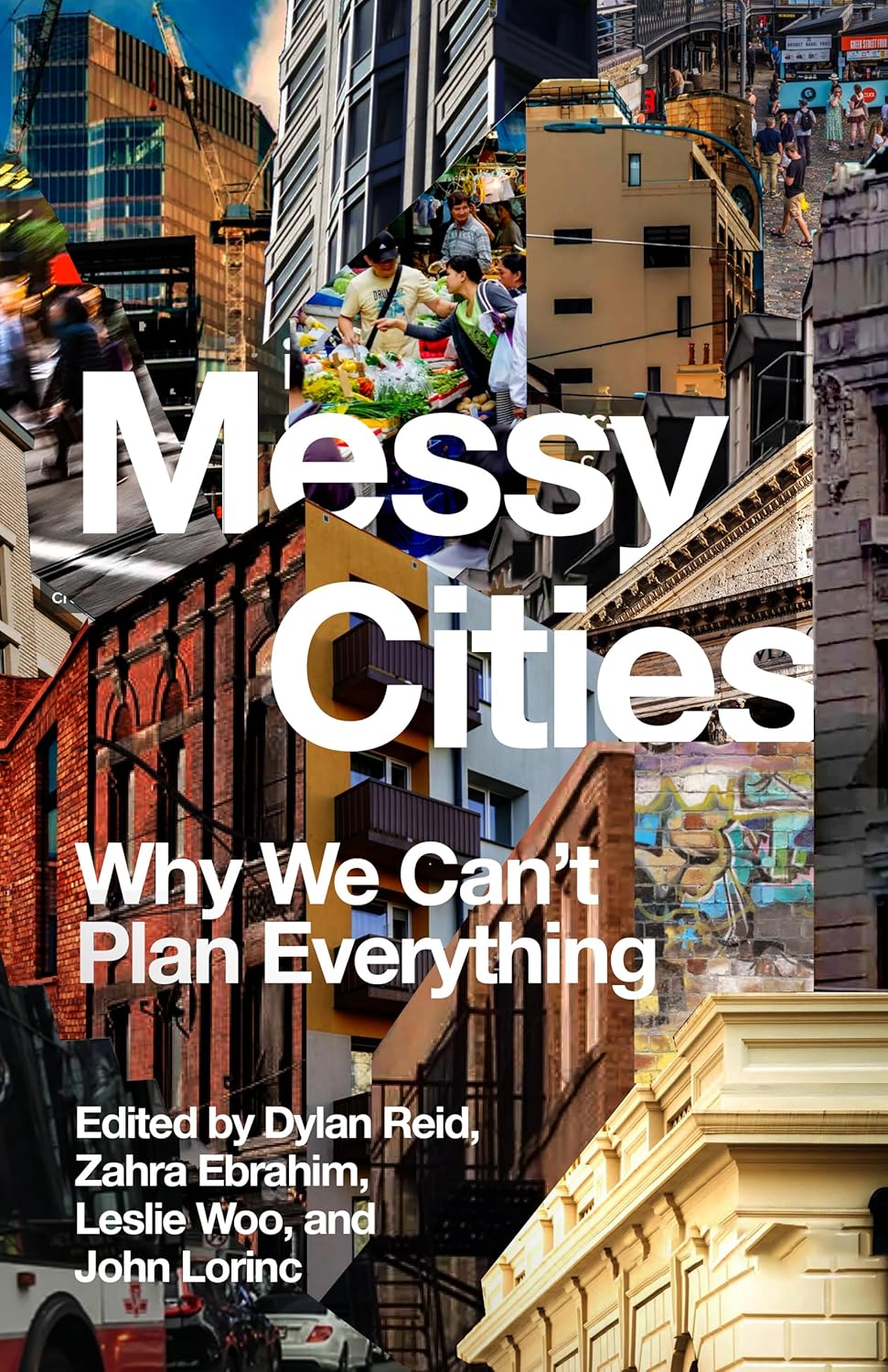
Messy Cities: Why We Can’t Plan Everything
Appropriately, I started this book just after having returned from five days in New York City. I was there for a two-day conference in Brooklyn, but I stayed in Tribeca, and spent some time walking the streets of that neighborhood and Soho. Between those sojourns and the subway to Brooklyn each morning, I got pretty good dose of a “messy city.”
I’m going to document the book in real-time below. It’s an anthology, so each chapter is a self-contained essay.
Introduction
Whomever wrote the introduction started off by talking about “desire lines” or “desire paths,” which are paths worn into the ground by where people actual want to want, rather than that’s planned. I enjoyed this quote:
They are the paths we take rather than the paths we are given.
And that really sets up the entire book.
The goal of this collection is to show that messiness is an essential element of the city… Messy urbanism needs championing, because out minds and instincts tend to default to the seemingly simpler options of seeking order.
I also enjoyed a quote from an separate article about “complexity” in a city, and what it demands of us:
…learning to interact well with strangers requires a toleration of ambiguity, the capacity to contain frustration, an ability to listen carefully to people whose speech, needs, or desires may seem alien.
Reflections
A Farewell to El Gran Burrito
This is an elegy for a Mexican street vendor in Los Angeles. The authors make the point that it was in a crappy building, but the food was amazing. The authors relate a story of visiting in the wee hours of the morning and being amazed by the cross-section of the people who were there – with an emphasis on the local queer community.
Sadly, the El Gran Burrito building got torn down to redevelop the area around it.
As urban planners and designers, we are schooled and trained to think that the best buildings and public spaces are born of grand visions framed by clean lines and filled with exquisite details.
[…] And what happens when they aesthetics get repeated as nauseum? You get a sameness in scale and look that makes cities almost indistinguishable from each other.
The authors ask how cities might avoid this sameness and codify protections for an eclectic mix of building types.
They use the word “vitality” a lot, which I suspect will come up throughout the book.
These Walls, These Roads
This is a very political essay from a Palestinian about the Israeli occupation of the land his family calls home.
His larger point seems to be that the forces that control a city can force other people into patterns of life that affect their sense of time.
How long is the bus stop wait? How long is the walk to the nearest grocery store? How many years of work until you can afford a home? How long is the co-op housing wait list? How about your commute.
He finishes with a reference to a concept called “right to the city.”
the right to full participation in the collective act of the city, the right to not only be from or belong to a place but to see yourself reflected in it and to partake in the creative act of shaping where you reside.
This essay seems a little out of place. I don’t deny the validity of the author’s experience, but I’m not sure how it relates to the purported subject of the book.
Living Loud: The Migration of a Steelpan Soundtrack
This is an essay about the noise of a city. The author was originally from Trinidad, where he was constantly subjected to noise.
He and his family immigrated to Toronto, and he discusses how the perception and toleration of noise is vastly different there.
The energy, the vibrancy, the joy of family noise has migrated to other countries and, carried miles and miles abroad, where it has not always been welcomed.
[…] It is no wonder that many from the south who venture to build new lives up north feel a chill not just of winter’s cold but of that silence.
I think his point is to promote the idea of noise as a key part of a vibrant city.
The good news is that we can live with noise. In the same was that the rhythm of our breath or our heartbeat steadies us. Noise is not a hindrance to a good life – it can propel a tidy life with a syncopation that can bridge oceans and cultures.
Planning for an Unplanned City
This is a discussion of whether we might have over-regulated cities. The author opens with a discussion of a Hanoi train that passes within inches of merchants and restaurant tables on it way out of the city, and how this would never be allowed in a Western city.
Have our rules and regulations squeezed too much of the life out of our cities? Or are they critical bulwarks for protecting public health and safety?
The author seems torn on the question. On the one hand, he wants more flexibility in how cities can respond to challenges, but on the other hand, he concedes that we need to keep people safe, and that flexibility in rules means they might be abused by people seeking to take an advantage:
Each of these, on its own, serves a valuable public purpose. In the aggregate, however, they can also preclue some of the dynamic urbansim that many cities are trying to recapture.
Interruptions
The author talks about their Toronto neighborhood, which is very dense, and how every neighbor is part of their neighbors’ lives. They borrow things from each other, know the entry codes to everyone’s house, and are constantly discussing their lives with each other.
I was recently sharing with some friends about colleagues about this resolving door of daily interruptions… They visibly recoiled at the prospect of interactions this intimate in their own living environments.
The author claims that living with this level of casual intimacy makes for better understanding between people.
There’s evidence that knowing people with vastly different lived experiences than your dramatically increased your capacity for empathy for them and others of their background. …it’s part of the social contract I think we agree to when we live in big cities.
No citation is given for that, but the other does also mention a 1995 Chicago heat wave where survival was linked to someone’s intimacy with their neighbors, which meant that groups of people would check on each other and make sure they were coping with the heat and not in distress (I assume there is some known evidence for this, though I didn’t find anything on the Wikipedia page).
The author discusses how they moved to Toronto from Vancouver, and how they believe they they were subconsciously looking for more closeness with neighbors. He cities his background in an Indian-Kenyan family, and makes a funny observation about American sitcoms like Family Matters and Full House where the neighbors (Steve Urkel and Kimmy Gibler, respectively) were always dropping in unannounced.
Packrat City
This is discussion of the author’s role as a “heritage planner” for the city of Toronto. Unfortunately, I couldn’t quite figure out what a heritage planner is. I searched for the author, and found her on v various platforms, but I still don’t have a great definition.
She starts the essay talking about how she keeps physical things that bring back memories. She calls herself a “packrat,” not a hoarder.
More recently, heritage planners have shifted toward a conversation paradigm that includes buildings not for their landmark status, but for the contextual role they play in the city. These buildings weren’t constructed to communicate nationalism, wealth, or grandeur, but they have more subtle stories to tell. The role of the heritage planner is to find those stories and determine whether and how to hold on to them.
That’s the closest I got to a definition.
Localities
An Argument Worth Having
This essay is by the head of the Chinatown Land Trust in Toronto, which is a type of organization that collectively owns land and allows members to vote on usage.
She writes that arguments and conflict are good. It means that people are engaged in the process and feel that their communities are worth arguing about and for.
I have come to believe that Chinatown’s ability to weather its storms comes from an organic level of protection – a healthy capacity for community conflict. In all its most dysfunctional and generative ways.
[…] I would pick a conflict with my co-op neighbor about who to hire for our giant plumbing contract next year over begging my landlord to let me turn on the air conditioner every summer.
Conflict means that people have skin in the game, and it implies that they want good resolutions because they need and plan to live with the consequences.
Dixie Road
This essay seemed to be a bit of a polemic against the suburbs. The author was an immigrant, and after moving to Toronto was immediately struck by how big the spaces were – how wide the streets were (hence the title), and how far away everything seemed.
The author proposes two changes:
- Greater variation in zoning requirements, allowing closer usages of land types
- A reduction in car-based regulations, such as street width, corner radii, and minimum parking requirements)
Suburbs across the country are victims of normative planning and development processes that prioritized the creation of a rapid revenue base through large-scale, rural-to-suburban land-use conversion and rigid, car-centric design standards.
A Beach Like No Other
This was essentially a story about a construction site and what a neighborhood did with it.
When a building was demolished and the ensuing construction was delayed, an empty lot appear in a neighborhood. Several people rallied around this lot, named it “Bloordale Beach” and began gathering there.
For most of the year and a half, Bloordale Beach existed as a gorgeous landlocked oasis, if not in its physical appearance, then in the community’s hearts and minds. The beach offered levity during the most difficult months of the pandemic.
The essay tells of a “Shared Space Initiative,” where Toronto designated certain spaces as “open” during the pandemic, but encouraged people to socially distance within them.
If the city would lighten up a little, like they did with the beach, and let us have some fun, who knows what other kinds of creations could emerge.
The Ballet of the Parking Lot
This is a discussion of “POPS” – Privately-Owned Publicly Accessible Space (the acronym doesn’t quite work). In particular, it’s discussing strip mall parking lots, which are private-owned, but have public uses.
The authors created a program they called “plazaPOPS” where they created more inviting spaces in these parking lots. They would install benches and tables, and invite social gatherings and public events to take place.
[The] parking lots may be unappealing, yet they anchor the city’s social life. Should strip mall plazas be considered part of the public realm?
What is Safety
This one is really out of place. It’s a discussion of an organization called Rainbow Railroad that helps LGBT people in oppressive countries immigrate to friendlier countries. The story is anchored around the suicide of a woman who attended a queer concert in Egypt and was persecuted for it.
There is very little tying this one to the topic of the book. There a few mentions of a housing crisis and how hard it is to find a place to live once you immigrate, but is essay is mainly concerned with explaining the plight of queer people in countries like Uganda and Afghanistan.
Why Can’t We Sell Stuff Anyplace?
This is… discussion (?) of zoning laws that prevent people from selling things wherever they want.
…why some cities, especially in the Global North, are so particular about where shopping can happen.
The essay discusses how shopping happens in other, less regulated, areas of the world – Hanoi, Istanbul, etc. – and then goes into a long-ish history of zoning laws and how we ended up separating business and residential areas.
In the end, other than highlighting the fact that the “Global North” tends to separate these areas, the author doesn’t seem to argue much in either direction. He seems satisfied to simply note the difference.
Desire Lines in the Sand
This essay is a discussion of Hanlan’s Point (or sometimes “Hanlan’s Beach”) in Toronto, which is an informal gathering place for the LGBT community and a generally accepted place for nudity in the city.
It discusses how the area morphed into its current use over the course of a century, which explains the “desire lines” of the title: some areas become what they are because there is a need for it among the populace, and they sort of just “claim” a space to fill the need.
For queer communities, desire lines symbolize the many ways that queer people have made places for themselves in cities that have often excluded or erased them.
The essay talks about an effort of the city to develop Hanlan’s Point into a entertainment district, and the grassroots counter-effort that sprung up to prevent the removal of a claimed area for the queer population of Toronto.
Conjay’s First Walk Home
This is a bit of fiction, about a boy named Conjay and his first day of second grade. He lives in the Toronto neighborhood of Little Jamaica.
In the story, he walks home with his friend Omar, but gets lost. However, he’s so familiar with his neighborhood – the people, the businesses, and the sights – that he’s able to find his way back.
It’s a bit cringey and utopian, but I get the point. When we go everywhere in cars, we’re insulated from landmarks and waypoints. But since Conjay lived in a neighborhood where he could walk, he was much more familiar with his surroundings.
Flexible Streets
This one is a little confusing because it starts with an anecdote about a blind woman and her dog. She is testing whether a new street configuration is navigable by the disabled. This made me think it was going to be about accessibility…
But it’s not. It’s about changing city streets to do more than just route cars. It discusses a bunch of different ways that cities have tried to get more use out of these streets: from little parks in parking spaces to Dutch streets that are considered an extension of the residents’ front lawns.
…as part of an increasing challenge to the dominance of the motorized vehicle, [the] boundaries are being blurred. Publish spaces are being reimagined and hybrid, flexible, or shared, their boundaries fuzzy and their functions bleeding into each other.
Leave the Leaves
This essay is an admonishment of the practice of cleaning up leaf waste. It makes the point that “leaf litter,” as its often called, plays an important role in the bio-chain and shouldn’t be packed up into bags and moved. It should just be left where it is.
Far from being waste, leaf little is an ecosystem – an damp, dark place of decomposition and regeneration. […] The landscape “cleaning up” choreography, timed with autumn’s arrival and repeated in the spring, is a ritual of harm. […] We’ve been trained by aesthetic conventions to view organic detritus as something that looks “messy.”
I identified with this one, quite a bit. I hate cleaning up leaves, and my wife loves how they look on the lawn. I’ll leave them as long as possible, and the only thing I’ll usually do is mulch them up in the mower. I would never bag them.
The essay was good: had a strong point and recommendation.
Non-humans (Heard and Unheard)
This one was really odd. It explained an exercise that the authors conduct in workshops (I gather that the authors are indigenous artists).
It’s a listening exercise. You are meant to listen carefully to all the sounds you hear. But has some odd angles.
For the next five minutes, do you have permission to listen? Can you remember how to hear the unheard sounds of non-humans? […] Acknowledge you are a visitor to this place, and attune to the sounds/vibrations as they enter your ears and move through/against your body.
I struggled to find anything meaningful here (I noticed that I didn’t highlight anything). However, when describing an after-exercise discussion, a participant said something interesting:
If we could only get rid of these sounds, we could have better listening.
That feels like an attempt to deny the reality of what is and replace it with the fantasy of what is desired.
My Teacher
This is a very short essay about a turtle laying her eggs, and more generally about the plight of many turtles in Toronto’s High Park and the dangers they encounter.
The lands have become a place that prioritizes human activity and often forgets the impacts of this activity on all of our animal and plant relatives.
Again, it’s very short. There’s not much of a point beyond the quote above.
Beyond the Lawn: Meadow or Mess?
This is a longer essay (the first one with subheaders) about a “pollinator habitat” front lawn that was cited by Toronto code enforcement. Unfortunately for the city, the person who maintained the habitat is a “professor of urban planning.”
The fight over this particular lawn apparently dragged on and was something of a cause celebre. The author eventually got a meeting with the mayor of Toronto about it, at which the mayor was presented with a comprehensive plan to reform the lawn to allow habitats like this. The author states that none of the reforms were ever implemented.
Interesting, the author cites a Canadian court precedent that says that the Canadian Charter of Rights and Freedoms…
…extends to protect expressions of environment values and beliefs reflected in natural gardens.
The author also calls out that laws on these situations are necessarily subjective:
A weed is simply an undesired plant, a flower growing in the wrong place.
And there’s some commentary on how traditional, manicured lawns imply something about society:
The lawn is all about order and control. Much has been written about this, along with its colonial roots. As a symbol of leisure and wealth introduced from Britain, the virtues of the clean-shaven lawn were extolled and emulated by American elites from Jefferson to Olmstead, and later, postwar, became integral to the identity of the suburban landscape. Facing the street, the front lawn signals conformity to neighborhood norms, order through homogeneity – a monoculutre cut to prevent sed, its fertility controlled.
I could not determine if the author ever had to cut down their habitat.
Book Info
- Author
- Zahra Ebrahim, John Lorinc, Dylan Reid, Leslie Woo
- Year
- Pages
- 336
- Acquired
- I have not read this book yet.
- A softcover copy of this book is currently in my home library.