The Fourth Turning: An American Prophecy - What the Cycles of History Tell Us About America’s Next Rendezvous with Destiny
TLDR: “Interesting, but highly speculative”
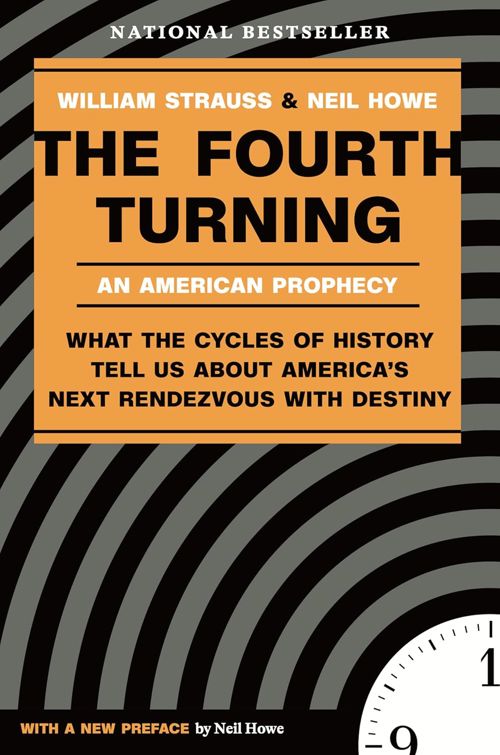
I did not read this entire book. I set out to “break” the book, like I did with Cooperation and Coercion a couple years back.
I read the cover material, the introduction, the conclusion, the index, then I went back through and read the first section of every chapter. And then I did a lot research on it.
The book is a little controversial. It was written in the late 1990s, and it introduced something called Strauss – Howe generational theory (named for the two authors).
The theory goes something like this –
History is divided up in to segments called “saeculums,” which are about the long human life – about 85 years. Each saeculum is divided up into four “turnings” of about 20 years. Those turnings proceed in order:
- The High
- The Awakening
- The Unraveling
- The Crisis
And then the cycle repeats.
The book is titled as such because when it was written in the late 90s, the authors claimed we had just ended an Unraveling, and we were headed into the fourth turning, which would be a Crisis.
This is somehow matched to generations. The generation someone grew up in falls into four categories:
- Prophet
- Nomad
- Hero
- Artist
Those “archetypes” correspond to turnings, and that’s what drives history.
…yeah, it gets a little metaphysical. Lots of people accused the authors of pseudo-science and a very selective view of history in order to get it to fit into their framework. It’s been called “unfalsifiable,” and therefore not valid science. Less complimentary critics have called it “voodoo” or “political astrology.”
But it also got a lot of press at the time, and a lot of people swear by the theory (it was recommend to me because the conservative pastor Douglas Wilson is apparently a big proponent of it). This was an updated version by one of the authors (the other one has since died), and he attempts to bring into the present and make present-day events fit the framework.
There’s also a documentary called Generation Zero (produced by Steve Bannon, of all people) that touches on some of the concepts. I watched it (it’s on YouTube), and it was interesting, but it’s more about the economic meltdown of 2008 (it was produced right after the housing crisis).
I didn’t buy all of it. I do believe that history is cyclic and events and the national zeitgeist tend to repeat, but some of the theory seems far-fetched. The book is a lot of examples trying to prove their theory. I skimmed quite a bit of it, and spent just as much time research the theory and other opinions of it.
It’s interesting and thought-provoking, but I wasn’t into it enough to spend 400 pages listening to people trying to prove that it’s true.
Book Data
- Author
- William Strauss, Neil Howe
- Year
- Pages
- 401
- Acquired
- Not recorded
- Open Library
- OL3289628W
- Wikipedia
- The_Fourth_Turning
- I have read this book. According to my records, I completed it on .
- A softcover copy of this book is currently in my home library.