Bad Company: Private Equity and the Death of the American Dream
TLDR: “Interesting, but didn’t totally convince me”
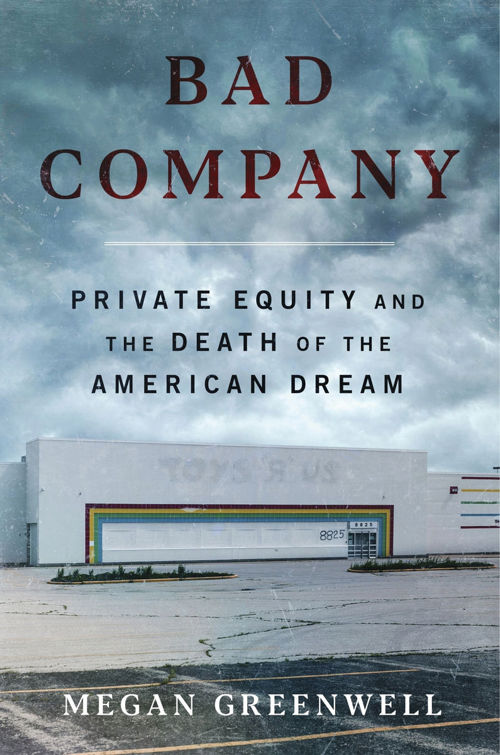
This book promises a global indictment of the business of private equity. But it didn’t deliver on that. What it did was tell four stories of specific cases of private equity associated with negative outcomes.
However, I’m not totally convinced that:
- …all private equity causes negative outcomes
- …in these examples, private equity was the thing that specifically caused the negative outcome
First of all, the book did teach me that private equity and venture capital are not the same thing. I had conflated the terms for years. VC is very early-stage money for speculative companies that may or may not work out. PE involves purchasing larger stakes in mature, running companies that someone thinks they can improve or simply because they generate a solid profit.
The book is organized around four stories:
- The acquisition of Toys R Us by a consortium of private equity funds
- A roll-up of two rural Wyoming hospitals by a large health care conglomeration
- The acquisition of a series of newspapers by a larger company
- One tenant’s experience with with apartment when a national apartment chain buys the building
(Actually, all the stories – not just that last one – are told from the perspective of specific people: a Toys R Us retail employee, a doctor at the hospital, a reporter at the newspaper.)
Here’s the biggest problem with the book –
At least two of the stories – Toys R Us and the newspapers – involve industries that were chronically failing at the time. The implication of the book is: these situations ended poorly, and private equity was the reason. Put another way, these organizations would have been fine if not for the PE activity.
I just don’t believe this is true.
Toys R Us was getting destroyed by Amazon and Walmart. The newspaper business was getting destroyed by the internet. The idea that they could have stayed independent and everything would have worked out for them is kind of laughable. Like I said before, I’m not convinced that PE was the cause of the negative outcome here (Toys R Us eventually liquidated, and almost every newspaper in the country is going under).
The other stories are a mixed bag. In the hospital example, the two facilities are 28 miles apart. The PE firm closes the maternity ward of one of them for the sake of less duplication of services, which infuriates the doctor at the center of the story. (It does seem that the acquiring firm was a little dishonest about their plans, but that’s not an argument against PE as a whole.)
What we have here is a difference in priorities. The doctor wants maximum patient care, while the PE firm wants maximum profit. The argument is, does closing the maternity ward of one of the hospitals to increase efficiency (and therefore profit) compromise patient care to a severe enough degree that it shouldn’t be done? Clearly, you’re going to get two different answers to that question from a physician or an investor, and where does the balance and power over the decision lie?
Consider that you really can’t have “maximum” patient care. That would involve a team of physicians waiting on every single patient at all times, which is a non-viable strategy. There always has to be some concession to economic and staffing realities… and who gets to make that decision? The argument of the book is that decision moved too far in the wrong direction, which is a management issue, perhaps exacerbated by the structure of private equity?
As for the last story about the apartment building, that seems to be the case of a specific landlord being crappy. Does that means all private equity is bad? No, it means that this particular PE firm was a bad landlord, but, again, I’m not ready to indict the entire industry over this.
There’s an inverse survivor bias at work here: these are the stories we hear about. Toys R Us was in the news because it was a storied American brand that fell apart. You don’t hear about many positive outcomes of PE acquisitions.
But they do happen. After I read the book, I went to breakfast with a friend who runs a regional PE company, managing multiple funds. He told me stories with great outcomes. For example, a small manufacturing firm could expand and grow, but the owners are older and don’t want to take the risk with their retirement. So the PE firm bought 75% of it, thus ensuring the financial safety of the owners, then invested the money to expand, and grew the company.
My friend says there are two ways to look at an acquisition:
- Grow it by increasing revenue and therefore profit
- Make it more profitable by cutting expenses
He likes that first one. He looks for companies that could expand. The second one is both hard from a human perspective (it almost always means layoffs – the companies are invariably described as “fat”), and it’s very hypothetical. Cutting expenses might work, or it might not.
But it works on a consulting slide, anyway, and this is usually enough to convince a bank. It’s not a coincidence that lots of PE companies also have business consulting groups attached to them.
I think PE struggles at scale, because, like anything, the further you are from something, the less important it is, and the less you consider the human costs of anything.
Additionally, the PE firms often don’t have enough at stake. They make “management fees” – 2% of the value of the investment is typical – and they load the target company up with debt (a “leveraged buyout”), so they’re not on the hook for much.
(For the life of me, I cannot figure out why banks agree to these things. Why were Bain, Vornado, and KKR not on the hook for the $5 billion they borrowed to buy Toys R Us? Is this is just lenders acting stupidly?)
In the case of my friend running the regional fund, he stays very close to the companies they buy. Between all their funds, they have maybe a half-dozen companies. He’s constantly in touch with them, visits the facilities regularly, etc. He told me of a recent decision to improve the health care benefit because (1) it would make it easier to retain and attract employees, and (2) it was just the right thing to do.
I think large-scale PE just makes it easier to “check your humanity at the door,” so to speak. When you’re running hundreds of hospitals, it makes it easier to not give a crap about a couple of them.
I do have concerns about PE in industries that are required for human survival and for which there are few alternatives. Health care and housing are two of those. No one needs Toys R Us and there are alternatives to print newspapers. But it’s hard to find alternatives to hospitals and housing. I’m not sure that rolling those up under large faceless firms is a great idea without some semblance of localized control and input.
So, it was an interesting book – it’s well-written, and the human aspect of the stories is engrossing. But I think it over-promised on the idea of proving the crappiness of an entire industry and then failed to deliver on it.
Update
Added on
I found an article that reinforces the book’s claim that PE killed Toys R Us, not Amazon:
The Amazon narrative also flatters Amazon. Take Toys R Us: in 2000, the toy chain signed a 10-year exclusive deal to sell on Amazon’s platform, paying $50 million a year and effectively surrendering its own e-commerce development. By 2003, Amazon was letting competitors sell toys on the same platform. Toys R Us sued, won, and terminated the deal in 2006, but it had lost six years of e-commerce development during exactly the period when online retail was being built. The company that then got loaded with $5.3 billion in LBO debt in 2005 was already competing with one arm tied behind its back. When Toys R Us collapsed, the narrative was “Amazon killed the toy store.” And sure, Amazon helped, but it was the LBO that extracted the cash flow and actually killed the company. Amazon got the credit, which translated into a market narrative about e-commerce invincibility that has bolstered its valuation ever since.
Book Info
- Author
- Megan Greenwell
- Year
- Pages
- 320
- Acquired
- I have read this book. According to my records, I completed it on .
- A hardcover copy of this book is currently in my home library.